Showing posts with label CERN. Show all posts
Showing posts with label CERN. Show all posts
Wednesday, January 22, 2014
Particle Fever
The video above is a trailer of an upcoming documentary about CERN and the discovery of the Higgs particle. This documentary looks wonderful and important. CERN has triumphed again at outreach and is simply leagues ahead of basically everyone else in science when it comes to this sort of thing. If anyone is surprised or wonders how CERN is able to get such a relatively large sum of science funding (though only relative to other science funding) then don't be. This sort of thing matters and makes a difference. People care about CERN because they know about CERN and they know about CERN because documentaries like this are made, made well, marketed well and received well.
The documentary itself will be released March 5, in New York, and hopefully will be viewable in most major locations, eventually, after that.
My only gripe is that it is coming 18 months after the Higgs discovery. I know that part of the motivation for this is that people want to make sure the science is definitely true before disseminating it, otherwise things can become confusing for the less engaged viewer. However, in July 2012 those guys were reasonably sure that they'd found something. This research is owned as much by the public as it is by the researchers. CERN did do a great job on that day by holding press releases, announcing the discovery live, with live web-streams, and with public level discussions, at the moment, of what the implications were. And, of course, this is all great, and I love CERN for it. But maybe it can be done even better.
Here's (potentially) how...
This documentary will probably be reasonably widely viewed. It looks like it is potentially headed for some major awards and it is being reviewed very favourably by a bunch of major newspapers and film critics.
Imagine if the film had been released, and widely viewed, immediately prior to the discovery's announcement, and the climax of the film was all the researchers, scientists, students, engineers, and everyone involved in this experiment waiting, full of anticipation, not knowing the result. The viewer now has a reasonable understanding of what the researchers were looking for and how they were hoping to find it. Now everyone is waiting, full of anticipation, not knowing the result. Then, we cut to the actual, live, not even the majority of the scientists know the result, announcement of the detection. The general viewer will now share in this discovery, that their taxes paid for (and who's future taxes will pay for future experiments) in the moment.
That's not just great for science outreach, it is genuinely good theatre for everyone involved (even if there isn't a detection). But most importantly it allows this sharing of not just the result, but the acquisition of the result. The public feels like they were there, like they took part, like it is also their discovery. And, to bring back the bottom line, when funding is next being decided, they want to be able to contribute to, and participate in, more discoveries like this.
Instead, people could tune in to the discovery, and see the researchers and scientists, etc, and their excitement, without being able to share in it.
Having said all of that, 18 months isn't that long. So, when the documentary is released, go watch it, and remember that this stuff happened less than two years ago. This is the present.
Twitter: @just_shaun

Monday, April 29, 2013
TEDx CERN
 |
| If you live in Helsinki come to our live webcast of the event. We will feed you. |
I had intended to write today's post on anomalies in cosmology. Unfortunately, I have suffered a crisis of confidence and have decided to postpone such a post for the future. I now have both a bunch of notes on the topic, left over from the Planck conference and a half-written post, left over from the weekend. The topic is a bit controversial and when I publish some thoughts on it I want to be very careful and precise so as not to accidentally annoy anyone.
Instead, I will tell you quickly about a really cool event that is taking place this Friday.
CERN is hosting a TED-x event. What is that? Well, a TED-x event is similar to a TED event, except that it isn't organised by TED itself. It is only endorsed by TED. What is TED? OK, well, TED is an organisation that organises a set of conferences around the world. The theme of the conferences is "ideas worth spreading" and speakers are given quite short time slots (typically less then twenty minutes) to express these ideas. Consequently the talks are often very fascinating as the speakers are forced to only say what really matters, leaving all the superfluous details aside. At the main TED events the speakers are also almost universally very good at giving talks, so the quality is high.
 |
| George Smoot, the host of the webcast/show. He has also been awarded one of the most illustrious honours any scientist can, a |
In fact, the TED realm of YouTube is one of the most dangerous black-holes of procrastination you can find. The shortness of the talks, combined with how interesting and intellectually stimulating they are is like the perfect storm of procrastination conditions. They don't last long enough for you to think that watching just one more is a problem. They are interesting, so you don't get bored. And they stimulate your mind so you don't even feel like you're using your time poorly (always my biggest procrastination danger). Then, half the day has gone.
Anyway, I have been making an analogy between science and sports in my mind for a long time now, and first wrote about it here more than a year ago. I really think that there is the potential for fundamental research to be as popular in today's society as sports is. Seriously! You might wonder why, if this is true, science isn't as popular as sports. Football matches fill out arenas and tennis players earn millions each year, entirely from the private sector throwing money at them to do nothing that is even remotely productive, yet even the highest profile fundamental research event of 2012, the discovery of the Higgs particle, was only front page news for a day.
Monday, September 3, 2012
Higgs: A view from the moment of discovery!
[Note from Shaun: When Mikko wrote us a guest post about the Higgs discovery he also gave me a short note he had written on the day CMS first opened their 2012 box and looked at the Higgs-relevant data. I decided to save that note for a rainy day. Today, is that rainy day (literally, in Helsinki). What follows is more or less exactly what Mikko wrote down the evening that he and about 100 other people first learned that they really had discovered an entirely new fundamental (probably) particle. The rest of us couldn't be there in that room, but we can read about it now!]
**** Do not open before July 9 *****
Recollections of a Higgs discovery
It's not official yet, and will not be for another three weeks, but you could say Higgs was finally discovered today, on Friday, 15th of June, 2012. More than fifty years of searching, and there it is, at 125 GeV, just like the first hints last December indicated.
The big occasion was the unblinding of the 2012 data set at a Higgs meeting held at CERN at 15:00 hours on Friday evening. The meeting venue, the non-descript Building 222 better known as the Filtration Plant, was stacked with CMS physicists, with half of the crowd sitting on the floor or leaning against the back wall. The air was dense from expectation, and immensely hot from the mass of people and failing ventilation.
Everybody was appropriately informed of the formal proceedings of the day: the slides would not be posted on the web, no recordings of the video meeting would be allowed (except an official one by the CMS Outreach Team), and nothing shall be leaked outside the collaboration after the meeting. Only the highest level of CMS management had seen all the results before, at a special preview held at 11am in the morning.
For the uninitiated, I should probably explain what the unblinding is all about. Scientists are intimately aware of unconcious biases in analysis, when the stakes are high and the statistics are low. Therefore, it is considered good practice to not look into the signal region before fixing the analysis procedure and cuts. The expected background in the signal region is estimated using side bands, and the analysis only proceeds to look in the signal region, the "box", when those side bands are found to be sufficiently well understood.
The Higgs group had agreed that nobody would look into the signal region of 2012 data before today (or yesterday evening really, to allow some time for analyzers to prepare their talks). The previous week was spent by review committees scrutinizing each of the analyses and making sure all the systematics were thought of and no obvious mistakes would remain. Only the analyses given official green light would be allowed to open the box, and the whole collaboration was invited to join the event.
A significant fraction of the three thousand collaborators apparently did indeed join, most of them remotely. From the first few minutes it was clear that the video meeting system was creaking and was barely holding the traffic. The outside world could hear the audio, and we could hear some of them (despite frequent reminders to mute), but the video feed was apparently stalling. With no slides posted, the people in the videoland were more or less blind.
All the more reason to feel privileged to be at CERN to listen to the talks in person.
The first three talks were strategically ordered to go from the channel with the worst mass resolution and lowest expected sensitivity to the one with best resolution and expected sensitivity. The HWW (Higgs decaying into two W bosons) analysis got the honor to be the first messenger.
After a bit of a jumpy start with switching lights on and off for better contrast on the video projector, trying to transmit slides outside CERN and accidentally dropping the network connection, the talk finally got up to speed. Several slides showing impressive agreement between data and simulation covered the sidebands before moving on to signal regions, with quite visible excesses. The bottom line: a little more than a three sigma excess with combined 2011(5/fb)+2012(3/fb) data, precisely in agreement with the standard model expectation for a 125 GeV Higgs. Hey, this starts to look quite promising!
After a few more minutes of more and less technical questions from the collaborators we turned to the Hgammagamma (Higgs decaying into two photons) channel. The talk was given by a young Chinese graduate student from MIT, who'd obviously absorbed the American style of putting a bit of drama into the talks. With skill she had the collaboration holding their breath waiting to see the new limit plots... with a gigantic peak and a local excess of more than 4 sigma at 125 GeV when combined with 2011 data.
At that point I had to fight a bit breaking into tears. Those two channels alone meant that we'd have to be above the 5 sigma discovery limit already. It would mean we had discovered the Higgs. After 50 years of searching. Us, here.
Ok, back to sobering up a bit. The signal was much stronger than expected from standard model, which means we had either got very lucky, or that this could be a non-standard-model Higgs. All the better, we might have more to discover later in the year. The measurements from different subcategories of photons pairs and from 2011 and 2012 looked all perfectly consistent so there was no hint of a measurement error.
The last of the big three talks was ZZ4l (Higgs decaying into two Z bosons, which in turn decay into four leptons). This is the ultimate channel with very little background so you could even claim with good probability that some individual events are from a Higgs boson decay, unlike in the background dominated HWW and Hgammagamma channels. The expectations were already high from the two previous talks, and the results certainly did not disappoint. Around half a dozen nicely clustered events right at 125 GeV, just like the standard model predicted.
It's interesting to note that improvements to the analysis, like Particle Flow based lepton isolation and recovery of photons radiated off the Z bosons, had both improved sensitivity and caused the secondary peak seen at 119 GeV in 2011 to disappear. The updated results combined with 2012 statistics made a very convincing case, racking up another 3 sigma or so.
The main trio was followed by a fourth talk on VH (Higgs produced in association with a vector boson, i.e. Z or W), which however had not yet been granted green light to open the box. Nevertheless, the analysts had made nice improvements to the analysis, gaining 50% more sensitivity out of the 2011 data, and showing a small excess consistent with standard model Higgs. A planned fifth talk on Higgs decaying into two tau leptons was postponed pending more checks, as was appropriate. The background checks before opening the box were clearly taken seriously.
Overall it was quite a tour-de-force, with all channels lining up in unison. This is still not all, because the analyses used only the first 3.9/fb of 2012 data collected until June 8, and in most cases even less. With 5.6/fb already in the can today and three more days to go to reach above 6/fb, the analyses will likely have about 50% more integrated luminosity for ICHEP. This might be enough to take some channels already above 5 sigma by themselves.
In the short summary the Higgs conveners reminded everybody that this is really a result by everybody in the collaboration, not just the Higgs group: thousands of people had contributed in building, maintaining and running the detectors, writing reconstruction software, calibrating the detectors, checking the data etc. The final analysis was only the tip of a large iceberg. And the work was not yet over, there was still plenty to do before presenting the results in Melbourne, Australia on July 9.
A final warning was given before people departed the room: smiles should be subdued and no champagne bottles should be popped in the cafeteria; there were filming crews outside that had not been allowed in the meeting room, and they had vowed to film the expressions on the people as they came out. We should not let the world know just yet ;)
At CERN in Geneva, Switzerland
June 15,
Wednesday, July 4, 2012
A Higgs Hunter's story...
[Note from Shaun: Here is Higgs hunter Mikko Voutilainen's account of the recent search for the Higgs. You can find the teaser to this post here. And my own, partially cynical, but ultimately upbeat, account of Higgs-things, here.]
Here it is, finally
[I assume the readers of this blog are somewhat familiar with the Higgs boson; if not, there's a nice summary on the CMS pages here]
So, this is the follow-up to the teaser I wrote a week ago. Now that everybody knows we found a Higgs boson at \(125.3\pm 0.6\) GeV, I'm free to talk about our finding, what it means and how we got there. Note the intentional use of 'a' Higgs there: although we, beyond reasonable doubt (less than one in a million chance of an error, to be precise), found a new particle, it's not 100% sure yet if it's *the* Higgs boson predicted by the standard model, or one of its many twins predicted by the hundreds of theories out there. There's even a tiny chance of it being an altogether different particle yet.
We actually already know a fair deal about this new particle besides the rather impressively precise estimate of its mass: it seems to be produced at a rate that matches the standard model prediction within about 20% uncertainty, it decays into bosons (W, Z and photon) and fermions (b-quarks and tau-leptons) roughly in the ratios predicted by the standard model, and in particular it decays into W and Z bosons in the ratio predicted by the standard model. The last point is rather important, because the Higgs mechanism, and the Higgs boson along with it, was invented to give mass to the W and Z bosons, and leave the photon massless. This also fixes the ratio of the decay rates to W and Z. If the new particle didn't decay into Z's and W's in just the right ratio, it couldn't be the Higgs boson we predicted.
We've also had a stab at determining the more abstract properties of the particle such as a quantum number called parity, but the statistics are low and the results still inconclusive. Predictions say we should be able to tell by the end of the current run, when we've collected 2--3 times the amount of data we have now. At this point we should also have more precise determination of the particle's decay rates in all the different channels, in order to gain more confidence in calling the particle a Higgs boson or something else.
So, is this the end, or the beginning of something new? I'm really hoping for the latter. If the new particle turns out to be 'just' the standard model Higgs boson and there's nothing new to be found, that would be fairly boring. If instead it's a Higgs twin, we may have just opened a window into a new landscape of particles.
At the moment it's too early to tell for sure, but there are a few interesting features to the way the new particle decays. It seems to decay into photons more often than expected, and to tau-leptons less often than expected. Taking all the decays to fermions together, they only seem to add up to about half of the rate predicted by the standard model, albeit with an error of about 50% as well. That coincidence is causing a bit of excitement nevertheless.
It might not be too bad for the standard model, though, it could just indicate that it's 'non-minimal'. While the Higgs coupling to W and Z is pretty tightly constrained, all the other particle masses are more of an ad-hoc addition to the theory, and there's some freedom to adjust how these particles couple to the Higgs boson without breaking everything else. Another good example of something that would require a 'non-minimal' standard model are the neutrino masses, which in the simplest expectation are exactly zero. We now know they are not zero, although we've still to nail down exactly how much they weigh (it's very very little in any case).
What for me was most interesting in this was to see first-hand how things have evolved towards a big discovery. Things started rolling about six months ago, when the first results from LHC Higgs boson searches were presented last December. Back then both ATLAS and CMS saw a hint of a Higgs at 125 GeV, with about 2-2.5 sigma statistical confidence. If you were a Higgs-believer, you could have given the signal more than 95% chance of being true.
After December it was decided that we wouldn't look at the 2012 data in the signal region before we had enough to confirm or refute the hint seen in 2011. This process is called blinding, and its important for making sure the analyzers are not unconciously affected by their prior expectations. Blinding is also one of the reasons we've tried to keep a lid on the results until today's seminar so that the experiments would not affect each other's findings between opening their signal box opening and presenting the final results. I think we were fairly successful in the end, although rumors started circulating on the blogs within days, and by yesterday almost every major newspaper (including Nature) had run a story on Higgs.
Between opening the signal box and seeing the first evidence of a new particle there was a whole lot of work going on for 2--3 weeks to prepare for ICHEP. The analyses added around 50% more data, the particle properties were studied in more detail, the CMS management had regular meetings with both ATLAS and CERN directors, people were working day and night to scrutinize the results, prepare documentation, etc. The final days were spent polishing plots, rehearsing presentations and fine-tuning press releases. Although I didn't happen to be at CERN during that period (I did attend the signal box opening in the beginning, though), I could at least participate through the almost daily video meetings and by keeping my own small piece of CMS running (I'm responsible for a team calibrating jets).
Just two days prior to the seminar there was also a presentation of the Tevatron Higgs results at Fermilab. The Tevatron people had done a superb job in squeezing every last bit of sensitivity out of their data and fell just a hair's width short of claiming evidence for the Higgs (they got 2.94 sigma by the most optimistic count, and needed 3.0). The Tevatron experiments collected data for ten years before shutting down last summer, and have the same amount of data (10 fb-1) available for analysis as the LHC experiments now. The lower collision energy of the Tevatron, 2 TeV versus 8 TeV at LHC, means roughly ten times less Higgs bosons are produced, but they still have better sensitivity in one single channel, the Higgs decaying into two b-quarks. I was watching that live on video, too, cheering for my old colleagues (I did my PhD on D0, one of the two experiments at the Tevatron).
And then, finally, today we had a chance to see how our colleagues and rivals at ATLAS were doing with their Higgs search. According to blog rumors, newspaper leaks and sensitivity estimate just a tad behind CMS, but never far. As it turned out, both CMS and ATLAS came up with the same significance in the end, within 0.1 sigma precision. Both experiments have now just made it to the 5-sigma milestone, and it's pretty clear that the signal has been effectively confirmed by at least three experiments (counting D0 and CDF together as a single Tevatron experiment).
P.S. I wrote a lengthy story about the box opening the same evening when I was at CERN, and stored it on a time capsule on my e-mail account. I'm not sure if it's interesting anymore, but at least I shouldn't be breaking any confidentiality rules by releasing it. [Shaun speaking: I now have this item in my possession, so if anyone wants to see it please let me know and I will upload it in a few days.]
Tuesday, July 3, 2012
On its own, a Higgs discovery would be grim (II)
[...continued from yesterday]
This is like, instead of mapping the entire globe, the ocean explorers found that they had simply reached the edge of all navigable land, and, as far as any vessel could see, beyond that, there was just apparently endless ocean. The explorers would know, from measuring the curvature of the Earth, that Earth was a globe and had a finite extent, but the radius of the Earth would be so enormous that they would never be able to come close to traversing it by boat. It would also be as if, on the last few islands this civilisation discovered, there were all sorts of indications that there must be new land out there somewhere. Only there was no way of knowing where, or how far away, it was. The Higgs, for these explorers, would be one, last, island, discovered far into the wilderness of this ocean, farther from the mainland than anything else except the top quark (another island, alone in the wilderness). To reach either island would require the finest ship imaginable and would require a journey of decades.
Such a civilisation would be left to wonder, 'what is it that is out there in that wilderness?' But, they would be unable to answer their question until the invention of the aeroplane hundreds of years later. The next land might be just over the horizon, or it could be on the other side of the globe. This world, is where particle physics will find itself if the LHC finds the Higgs and nothing else.
The LHC's great, great grandparent in this journey of exploration was Ernest Rutherford who fired alpha particles at gold and discovered the atomic nucleus. Where Rutherford was the first of this kind, the LHC (or ILC) might be the last. For just over 100 years, collision experiments have been one of the driving forces of fundamental physics. The photos interspersed throughout this post show a collection of some of the more famous colliders during this period. But, just as the days of the ocean explorer had to eventually come to an end and the romantic tales of discovery that came with them ceased to be written, so might we have to fare colliders well and accept that the Higgs is the last of its kind.
If such an event occurs, a thought should be spared for all the map-makers of this oceanic world (the theoretical physicsists of the last thirty years), who, for decades, have built ever more complicated maps showing that Higgs island would not be alone. They had fascinating and compelling arguments for why Higgs island should be surrounded by exotic new islands, completely different to anything we've encountered before, many maps even showed new continents. The map-makers will have built entire careers making those maps, but if the islands and continents turn out not to be next to Higgs island, they're simply not there; however much we thought they should be. Of course, these continents may very well still exist, somewhere out of HMS Large Hadron Collider's range, but the map makers themselves would never get the chance to know.
This is like, instead of mapping the entire globe, the ocean explorers found that they had simply reached the edge of all navigable land, and, as far as any vessel could see, beyond that, there was just apparently endless ocean. The explorers would know, from measuring the curvature of the Earth, that Earth was a globe and had a finite extent, but the radius of the Earth would be so enormous that they would never be able to come close to traversing it by boat. It would also be as if, on the last few islands this civilisation discovered, there were all sorts of indications that there must be new land out there somewhere. Only there was no way of knowing where, or how far away, it was. The Higgs, for these explorers, would be one, last, island, discovered far into the wilderness of this ocean, farther from the mainland than anything else except the top quark (another island, alone in the wilderness). To reach either island would require the finest ship imaginable and would require a journey of decades.
 |
| The Large Electron Positron Colllider (most accurate measurer of the precision electroweak parameters) |
Such a civilisation would be left to wonder, 'what is it that is out there in that wilderness?' But, they would be unable to answer their question until the invention of the aeroplane hundreds of years later. The next land might be just over the horizon, or it could be on the other side of the globe. This world, is where particle physics will find itself if the LHC finds the Higgs and nothing else.
The LHC's great, great grandparent in this journey of exploration was Ernest Rutherford who fired alpha particles at gold and discovered the atomic nucleus. Where Rutherford was the first of this kind, the LHC (or ILC) might be the last. For just over 100 years, collision experiments have been one of the driving forces of fundamental physics. The photos interspersed throughout this post show a collection of some of the more famous colliders during this period. But, just as the days of the ocean explorer had to eventually come to an end and the romantic tales of discovery that came with them ceased to be written, so might we have to fare colliders well and accept that the Higgs is the last of its kind.
If such an event occurs, a thought should be spared for all the map-makers of this oceanic world (the theoretical physicsists of the last thirty years), who, for decades, have built ever more complicated maps showing that Higgs island would not be alone. They had fascinating and compelling arguments for why Higgs island should be surrounded by exotic new islands, completely different to anything we've encountered before, many maps even showed new continents. The map-makers will have built entire careers making those maps, but if the islands and continents turn out not to be next to Higgs island, they're simply not there; however much we thought they should be. Of course, these continents may very well still exist, somewhere out of HMS Large Hadron Collider's range, but the map makers themselves would never get the chance to know.
Monday, July 2, 2012
On its own, a Higgs discovery would be grim
 |
| Rutherford, with the first ever particle collider |
Why the Higgs is cool
If rumours are to be believed, then, in two days time, CERN will announce the discovery of a new particle and it will be called Higgs. To the degree that the discovery of any new particle is a pretty big deal, this will be a pretty big deal.
To put things into perspective, not only will this be the discovery of an entirely new particle, if the standard model of particle physics is correct, this will also be the discovery of an entirely new fundamental particle. That is, it won't be made up of any constituent pieces. Also, the field that it will be excited from will not have been directly detected ever before. And that's not even it. Other aspects of the Higgs are also completely new. For example, the way it behaves when you rotate it will be unique amongst all the fundamental particles we've discovered so far, which is quite curious because its rotational properties will be the simplest (i.e. it has no spin at all).
So, irrespective of everything I'm about to write I want to first stress the following: the discovery of a Higgs-like particle is pretty damn cool and a great achievement of exploration for humanity.
Beyond the hype
However, the Higgs is no God particle and it is not the origin of all the mass in the universe (or even a significant proportion of it). No great mysteries of the universe are about to be solved on Wednesday. The Higg's significance in our understanding of the universe is similar to the understanding gained when the last piece of a jigsaw is finally placed in a puzzle. Placing that last piece produces an enormous amount of cathartic pleasure (more so than any other individual piece). But, the image in the puzzle has become clear long before that final piece is placed. The role the Higgs plays in the standard model of particle physics is to break a certain symmetry in nature, the electroweak symmetry. All the other pieces of this broken symmetry have been found, some quite a long time ago.
Monday, June 25, 2012
The Higgs: To be, or not to be?
[Note from Shaun: The following is a guest post from Higgs Hunter, Mikko Voutilainen. Mikko is a colleague of mine here in Helsinki. He is a postdoc working on the CMS experiment at the LHC in CERN. Below, he rhetorically asks the Higgs boson whether it exists or not. The irony of this is that Mikko asks this question, non-rhetorically, for a living and it is quite possible that he has already received an answer. He cannot (unfortunately) tell us this answer, yet. You should consider the following a teaser for what will follow next Wednesday when CERN unveils its latest results to the world. On that date, Mikko has promised to give us another guest post where he will reveal everything he knows about, The Higgs... (I've even heard rumours that this follow-up post has already been written)]
To be, or not to be?
That's a question for the Higgs boson to answer, and we might know soon enough. CERN just (well, three days ago really, but everybody here was out in the countryside celebrating Midsummer) published a press release about having a seminar on the new results on Wednesday 4th of July.
Coincidence that it's also Independence Day for the folks in the US? Probably yes, although my collaboration, the Compact Muon Solenoid (CMS) experiment at CERN, does have a strong representation from the States, including our spokesperson Joe Incandela.
The real reason, though, is that the 4th of July is also the eve of a major particle physics conference, ICHEP, starting in Melbourne. The ATLAS and CMS experiments will deliver the preliminary results of their 2012 data analysis there, and the seminar will be a kickoff for these presentations (you can see the live broadcast at webcast.cern.ch).
The experiments at the Large Hadron Collider stopped collecting data only on the 18th of June, and everybody is now busily analysing this dataset. We actually collected quite a nice bunch of data, just over 6/fb, which is a bit better than last year. The collision energy was also raised from 7 TeV to 8 TeV, which should increase the production rate of possible Higgs bosons by 20--30%.
People are really eager to see the new results, and for a reason. The data collected in 2011 showed some hints of a Higgs boson in the 124-126 GeV range. The amount of data collected this year is nearly equal to that collected last year so the results are directly comparable. We should be able to see whether the earlier trends are still there, or whether they've gone away. Either way, it should be pretty exciting.
The predictions made earlier indicate that a combination of the 2011 and 2012 datasets should get pretty close to five sigma, the traditional standard for a discovery in the field. Or, we should be able to rule the existence of the Higgs boson out at a 95% confidence level from the whole remaining mass window.
What happens in a week depends both on the hard work of the physicists, who are improving the sensitivity of their analysis, and, due to statistical fluctuations, pure luck. If we're unlucky, the existence of the Higgs boson may still remain a mystery, but if we're lucky, we might end the quest earlier than expected.
So, what if we find the Higgs or not? Is it the answer to Life, the Universe, and Everything? Or a piece in the puzzle of the origin of mass for the elementary particles? The latter, more likely.
If we find that the Higgs boson lacks existence, much of the theoretical work done in particle physics for the past few decades will end up in the dustbin. It's not all that bad, really, because it will allow the theorists to start from a clean slate, and that's often been a very fruitful thing. The experimentalists will continue to hunt for other particles that could replace the Higgs boson.
If the Higgs boson is found, it's properties will have to be scrutinized carefully. There are many theories out there besides the Standard Model of particle physics that predict the Higgs boson (or bosons) so determining it's precise identity might take a while. Many of the alternative theories also predict other particles, leaving plenty of work to be done for the experimentalists.
[Note: Mikko writes for a Finnish language blog, Higgs Hunters. This post is an English translation of his latest post at Higgs Hunters.]
To be, or not to be?
That's a question for the Higgs boson to answer, and we might know soon enough. CERN just (well, three days ago really, but everybody here was out in the countryside celebrating Midsummer) published a press release about having a seminar on the new results on Wednesday 4th of July.
Coincidence that it's also Independence Day for the folks in the US? Probably yes, although my collaboration, the Compact Muon Solenoid (CMS) experiment at CERN, does have a strong representation from the States, including our spokesperson Joe Incandela.
The real reason, though, is that the 4th of July is also the eve of a major particle physics conference, ICHEP, starting in Melbourne. The ATLAS and CMS experiments will deliver the preliminary results of their 2012 data analysis there, and the seminar will be a kickoff for these presentations (you can see the live broadcast at webcast.cern.ch).
The experiments at the Large Hadron Collider stopped collecting data only on the 18th of June, and everybody is now busily analysing this dataset. We actually collected quite a nice bunch of data, just over 6/fb, which is a bit better than last year. The collision energy was also raised from 7 TeV to 8 TeV, which should increase the production rate of possible Higgs bosons by 20--30%.
 |
| The amount of data collected in 2010, 2011 and 2012. One fb-1 amounts to almost 100 trillion proton-proton collisions. |
People are really eager to see the new results, and for a reason. The data collected in 2011 showed some hints of a Higgs boson in the 124-126 GeV range. The amount of data collected this year is nearly equal to that collected last year so the results are directly comparable. We should be able to see whether the earlier trends are still there, or whether they've gone away. Either way, it should be pretty exciting.
The predictions made earlier indicate that a combination of the 2011 and 2012 datasets should get pretty close to five sigma, the traditional standard for a discovery in the field. Or, we should be able to rule the existence of the Higgs boson out at a 95% confidence level from the whole remaining mass window.
 |
| Predictions for the significance of a Higgs signal as a function of the boson mass. The combination of 2011 (5 fb-1, 7 TeV) and 2012 (5 fb-1, 8 TeV) data will correspond to roughly the average of the two red lines. |
What happens in a week depends both on the hard work of the physicists, who are improving the sensitivity of their analysis, and, due to statistical fluctuations, pure luck. If we're unlucky, the existence of the Higgs boson may still remain a mystery, but if we're lucky, we might end the quest earlier than expected.
So, what if we find the Higgs or not? Is it the answer to Life, the Universe, and Everything? Or a piece in the puzzle of the origin of mass for the elementary particles? The latter, more likely.
If we find that the Higgs boson lacks existence, much of the theoretical work done in particle physics for the past few decades will end up in the dustbin. It's not all that bad, really, because it will allow the theorists to start from a clean slate, and that's often been a very fruitful thing. The experimentalists will continue to hunt for other particles that could replace the Higgs boson.
If the Higgs boson is found, it's properties will have to be scrutinized carefully. There are many theories out there besides the Standard Model of particle physics that predict the Higgs boson (or bosons) so determining it's precise identity might take a while. Many of the alternative theories also predict other particles, leaving plenty of work to be done for the experimentalists.
[Note: Mikko writes for a Finnish language blog, Higgs Hunters. This post is an English translation of his latest post at Higgs Hunters.]
Monday, March 12, 2012
Art and Elsewheres
 |
| Hiroshi Sugimoto, Surface of Revolution with Constant Negative Curvature, 2008 |
I’m interested in abstraction as a real issue for creative collaborations between art and science. As I wrote in my last post, science habitually turns to orders of abstraction and mind-bendingly variable magnitudes of scale when it turns to mathematics; but ‘abstraction’ also has a very specific meaning for art, and especially modern painting. So what happens when you put these two kinds of abstraction — mathematical and aesthetic — together?
Mathematics: A Beautiful Elsewhere was an exhibition at the Fondation Cartier pour l’art contemporain, Paris late last year that put leading mathematicians and artists into contact with a open collaborative brief. The curator quotes the mathematician Alexandre Grothendieck to describe the exhibition’s aim as offering visitors “a sudden change of scenery.” The show was unusual enough to elicit some thoughtful response, not least a long interview with David Lynch, who contributed a film. "If you think of cosmology, you picture colourful nebulae; with neurology, intricate brain scans," notes the New Scientist. "But what does mathematics look like?" The answer is, implicitly, abstraction. The Nature review was a bit more curmudgeonly, accusing both the artists and the mathematicians of insufficient or obtuse communication. Other pieces in the show included included a live video feed from the CMS and ATLAS experiments at the Large Hadron Collider in CERN, Geneva: a groundbreaking-everyday kind of experiment which this reviewer — an astronomer — describes as "the mathematical word made flesh." For another commentator, the dominant theme was mystery:
Mystery is perpetuated not only within the pieces and puzzles themselves, many of which are initially impenetrable to the mathematically untrained. It also lies more fundamentally within the very essence of the subject under examination. The message runs clear throughout: mathematics is in itself a mystery, the truth of which may never be attained.
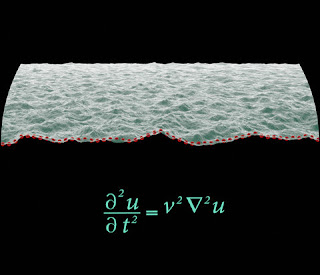 | ||||
| Sea Waves (wave equation) image from the film Mathematical Paradises, 2011. |
Talking with Shaun recently about fractals and the questions they raise — are they art? are they science? Does the mathematical basis and quality of endlessness make this an 'aesthetic' or a 'natural' object? — reminded me of the persistent problem of vocabulary for the desire to talk across these particular disciplinary lines. In a book titled What is Philosophy?, a collaboration between a philosopher and a practicing psychoanalyst, Giles Deleuze and Felix Guattari express the problem in this way:
When philosophy compares itself to science it sometimes puts forward a simplistic image of the latter, which makes scientists laugh. … Paul Klee’s vision was certainly more sound when he said that mathematics and physics, in addressing themselves to the functional, take not the completed form but formation itself as their object. … If philosophy has a fundamental need for the science that is contemporary with it, this is because science constantly intersects with the possibility of concepts and because concepts necessarily involve allusions to science that are neither examples nor applications, nor even reflections.
(Deleuze and Guattari, What is Philosophy? 154-5, 162)
 |
| Ulam’s Spiral, in The Room of the Four Mysteries, part of a film by Beatriz Milhazes. |
It strikes me that Mathematics: A Beautiful Elsewhere is an attempt in the right direction at a real space of collaboration — the kind of thing that Deleuze and Guattari would call taking "not the completed form but formation itself as [its] object." This is for a couple of reasons. One, the sheer range of works and collaborations in the show. Each is a sincere attempt to bridge the gap through multiple types of visual languages, and in a range of different media, and no individual piece can claim to individually crack the problem. This variety is an important part of making the viewer aware of the potential heterogeneity of the art/science matrix. By comparison, the CERN residency picked only a single artist following a wide call for proposals, which is a relatively pre-determined approach that is more likely to fall into the trap of fixating on artistic personality.
Second, Michel Cassé — an astrophysicist and a co-curator of the Mathematics show — put a range of experienced specialists together, gave them an open brief, but required the outcome to take the form of an art exhibition. This is a useful constraint for a topic so predisposed to wander into the literally ineffable. And so, for all the occasional accusations of impenetrability by the critics, this is an approach to disciplinary collaboration that I hope we see more of in contemporary art: process-oriented, carefully conceptualized collaborations that are not just flashy "allusions to science" but that prioritize the actual objects, methods, and incipient discourses that might fail, may communicate only partly, but begin to construct the common vocabulary.
 |
| Live video feeds from experiments at the Large Hadron Collider in CERN, Geneva |
Friday, September 23, 2011
Yet another voice in the neutrino OPERA
I
feel just a little prophetic, given that only a week ago I wrote,
“... it is also useful to simply measure as many new things as possible. History is littered with moments where we didn't bother measuring something because we knew what the result would be, only to get a big surprise whenever someone finally did measure it. So nowadays if something is measurable, then someone, somewhere, is trying to measure it.”
Well,
true to the claim, someone out there had the ridiculous idea that
measuring the speed of neutrinos was a good idea, go figure. And, lo and behold, it seems they've found something! Maybe? Who knows!
Well,
what sort of blog writer, who is a scientist (physicist even), would
I be if I didn't join in with the neutrino cacophony? So, what follows is
my attempt to say something interesting that hasn't already been said
a million times already. I will focus on why this is
such a surprising result and why this means nobody believes it.
This
disbelief has nothing to do with the quality of the experiment. The
measurement was recorded with impeccable accuracy and has been
extremely carefully analysed. Neither is the disbelief because the
result "proves Einstein wrong". It even has very little
to do with the prospect of over-turning special relativity.
The disbelief is due
to the fact that this observation brings into question the holy
principle of causality – that is, the seemingly incontrovertible
fact that cause must come before effect and not after
And,
as my former PhD supervisor, said in the Guardian today:
“If we do not have
causality, we are buggered."
Friday, September 2, 2011
Arts@CERN
I received a nice email today from Gareth, a good friend and follower of this blog. He forwarded me a link to something called Collide@CERN, which seems very relevant to the blog's purpose.
Follow @just_shaun
Before talking about Collide@CERN, let me briefly discuss CERN. CERN is the particle physics laboratory that houses the Large Hadron Collider (LHC). The LHC really is an incredible experiment, not just because of what it is measuring, but also because humanity decided to pool enough of its resources together and devote enough collective time to it to actually build and use it. I won't go into detail as to what the LHC actually does (CERN does a very good job of publicising this themselves – and perhaps Gareth might be tempted into writing a guest post for us) but it is definitely the most important particle physics experiment that exists today and is basically studying what nature does at the smallest lengths and highest energies that we have ever studied. Coincidentally, very early on in its history, the universe was extremely hot and dense, so the laws and patterns observed by the LHC are also very relevant to the early stages of the universe. This is why CERN will often claim that the LHC is “recreating the conditions during the big bang”.
In any case, CERN have always been very, very good at outreach. It doesn't really surprise me that the most ambitious and most difficult experiment humanity has ever attempted is run by an organisation that tries so hard and so effectively to explain and popularise what it does. People care about what they know about and they know about what they are introduced to. If anyone is ever visiting Switzerland, it is well worth it to actually visit CERN. Not only will you be participating in a sort of high energy physics pilgrimage, but you should find CERN well catered to non-specialist tourists as well. I'd even go as far as to say you should consider visiting Geneva just to see CERN!
If I can allow myself to get to the point, Collide@CERN is a programme CERN is just starting that goes beyond just outreach and is part of a concerted effort by CERN to actively engage with the arts through what they've called Arts@CERN. Collide@CERN is a competition for artists. From the press release I linked to:
"The prize consists of a two-part residency. Two months will be spent at CERN, where the winning artist will team up with a scientist as inspirational partner; then one month will be spent at Ars Electronica, where the artist will develop work inspired by the time spent at CERN."The programme seems to have some prominent artists behind it, as well as reasonably substantial funding.
I've always found CERN's contribution to science popularisation impressive. These new steps impress me even more. I'm intrigued to see how Arts@CERN develops. Perhaps some of our current and/or future readers might even be interested in entering the competition.
For anyone on twitter... both @CERN and @ArtsAtCERN have twitter accounts. Follow @just_shaun
Subscribe to:
Posts (Atom)