Showing posts with label public. Show all posts

Monday, November 26, 2012

Open Sesame! - Diplomacy through science


For as long as I can remember being even remotely aware of international politics I have known one thing to be certain: Arabs and Israelis don't get on! It's a fact that I've grown up knowing and has been reinforced time and time again in recent years with seemingly unbreakable cycles of violence and ever more dangerous and confrontational political rhetoric from both sides. The most recent exchanges of ammunition between Gaza and Israeli cities is simply the latest chapter in this sad tale of a fractured region.

But how will the story end? Little diplomatic progress has been made in the resolution of the conflict in the 60 years that it has been raging, and indeed the conflict has spread to bring countries such as Iran and Pakistan into the front line of political warfare. The historic, cultural, and religious differences between the two sides seem simply too insurmountable to overcome, and so a bloody (and potentially radioactive) conclusion seems a terrifyingly possible outcome.

Yet, in the midst of all the hatred and mistrust, there is a glimmer of hope on the diplomatic front that has come in the form of a collaborative scientific project. Sesame, which stands for 'Synchrotron-light for Experimental Science and Applications in the Middle East', is a multi-million dollar particle accelerator currently under construction near Amman, Jordan. Synchrotrons are fantastically useful facilities capable of producing a form of light known as synchrotron radiation that can be harnessed to investigate materials on unbelievably tiny scales. One such application is the study of proteins and other biological molecules down to atomic scales such that their structure and function can be better understood, and potentially so that we can develop more sophisticated drugs to target them. I recently wrote about the 2012 Nobel Prize for Chemistry awarded to Robert Lefkowitz and Brian Kobilka, which would have been entirely impossible without facilities such as Sesame. 

Monday, November 12, 2012

Shaken not stirred - how to extract your own DNA


Last week I eagerly sat down to watch the first episode of a new series: Dara O Briain's Science Club. For those of you from outside the British Isles, Dara O Briain is an Irish comedian who, in recent years, has become one of the most popular comedians and broadcasters in the UK. Not only is he a very funny guy, he's also got a pretty sharp mind inside his (frankly massive) shiny head: he studied mathematics and theoretical physics at University College Dublin and has managed to hang on to his love of science despite moving into the world of entertainment. He, along with other big names like Brian Cox and James May, has been instrumental in advancing British popular science broadcasting in the last decade and has presented a number of science programmes, such as School of Hard Sums and Stargazing Live, giving science that much-needed welcoming and friendly face. 

His new series is most definitely worth watching and I await the next episodes with bated breath. The first was on the subject of genetics and epigenetics and my curiosity was more about how these complex topics would be presented rather than actually learning something (I'm already fairly familiar with the fields)! I was delighted by the casual and approachable way in which it was structured, and how debates about scientific funding and application were mixed in with the hard facts. 

Possibly my favourite moment, however, was when we were shown how to perform a simple task that I am very used to doing in the lab, but in your own home: extracting DNA. Perhaps appropriately given the latest addition to the James Bond franchise, this entailed the use of cocktail-making equipment and the kind of very strong vodka needed to make that perfect Martini. Some might think of this as a big gimmicky and irrelevant, but I quite like the idea of making somewhat abstract scientific principles more tangible in the mind of the general public. Bringing such a standard research procedure into people's homes helps to demystify the scientific method and hopefully give people a greater sense of ownership over this work than they might otherwise have.

So, today's post is a shameless plug for Dara O Briain's Science Club with the aforementioned DNA recipe thrown in for those of you unfortunate enough not to be able to watch it online! Enjoy.


1. Collect some of your cheek cells by swishing some (around 100ml) salt water around your mouth for 30 seconds or so. The solution will be a bit cloudy afterwards.

2. Add a few drops of washing-up liquid (to dissolve the cells' membranes) and a shot of pineapple juice (the proteases in this will degrade the myriad proteins found in your cells). Pop it all into a cocktail shaker and give it your best shake!

3. Pour through a cocktail strainer to remove bubbles, ideally into a martini glass or something in which it's easy to layer different liquids.

4. Chill some very strong (>80% abv) vodka on ice and they carefully layer over the top of your mushed up cell solution. At such a high concentration of alcohol DNA comes out of solution and so precipitates at the boundary between the two solutions. This looks like a white cloud forming at the bottom of the vodka layer, which can be scooped out by wrapping it around a toothpick or something similar. Et voilà! It may not look like much, but you have successfully extracted the chemical instructions that make you you. Not bad for 5 minutes work.


Monday, March 12, 2012

Art and Elsewheres

Hiroshi Sugimoto, Surface of Revolution with Constant Negative Curvature, 2008

I’m interested in abstraction as a real issue for creative collaborations between art and science. As I wrote in my last post, science habitually turns to orders of abstraction and mind-bendingly variable magnitudes of scale when it turns to mathematics; but ‘abstraction’ also has a very specific meaning for art, and especially modern painting. So what happens when you put these two kinds of abstraction — mathematical and aesthetic — together?

Mathematics: A Beautiful Elsewhere was an exhibition at the Fondation Cartier pour l’art contemporain, Paris late last year that put leading mathematicians and artists into contact with a open collaborative brief. The curator quotes the mathematician Alexandre Grothendieck to describe the exhibition’s aim as offering visitors “a sudden change of scenery.” The show was unusual enough to elicit some thoughtful response, not least a long interview with David Lynch, who contributed a film. "If you think of cosmology, you picture colourful nebulae; with neurology, intricate brain scans," notes the New Scientist. "But what does mathematics look like?" The answer is, implicitly, abstraction. The Nature review was a bit more curmudgeonly, accusing both the artists and the mathematicians of insufficient or obtuse communication. Other pieces in the show included included a live video feed from the CMS and ATLAS experiments at the Large Hadron Collider in CERN, Geneva: a groundbreaking-everyday kind of experiment which this reviewer — an astronomer — describes as "the mathematical word made flesh." For another commentator, the dominant theme was mystery: 
Mystery is perpetuated not only within the pieces and puzzles themselves, many of which are initially impenetrable to the mathematically untrained. It also lies more fundamentally within the very essence of the subject under examination. The message runs clear throughout: mathematics is in itself a mystery, the truth of which may never be attained. 
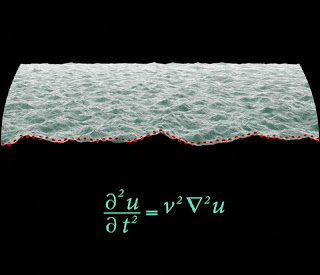
Sea Waves (wave equation) image from the film Mathematical Paradises, 2011.


Talking with Shaun recently about fractals and the questions they raise — are they art? are they science?  Does the mathematical basis and quality of endlessness make this an 'aesthetic' or a 'natural' object? — reminded me of the persistent problem of vocabulary for the desire to talk across these particular disciplinary lines. In a book titled What is Philosophy?, a collaboration between a philosopher and a practicing psychoanalyst, Giles Deleuze and Felix Guattari express the problem in this way:
When philosophy compares itself to science it sometimes puts forward a simplistic image of the latter, which makes scientists laugh. … Paul Klee’s vision was certainly more sound when he said that mathematics and physics, in addressing themselves to the functional, take not the completed form but formation itself as their object. … If philosophy has a fundamental need for the science that is contemporary with it, this is because science constantly intersects with the possibility of concepts and because concepts necessarily involve allusions to science that are neither examples nor applications, nor even reflections.
(Deleuze and Guattari, What is Philosophy? 154-5, 162)
Ulam’s Spiral, in The Room of the Four Mysteries, part of a film by Beatriz Milhazes.

It strikes me that Mathematics: A Beautiful Elsewhere is an attempt in the right direction at a real space of collaboration — the kind of thing that Deleuze and Guattari would call taking "not the completed form but formation itself as [its] object." This is for a couple of reasons. One, the sheer range of works and collaborations in the show. Each is a sincere attempt to bridge the gap through multiple types of visual languages, and in a range of different media, and no individual piece can claim to individually crack the problem. This variety is an important part of making the viewer aware of the potential heterogeneity of the art/science matrix. By comparison, the CERN residency picked only a single artist following a wide call for proposals, which is a relatively pre-determined approach that is more likely to fall into the trap of fixating on artistic personality.

Second, Michel Cassé — an astrophysicist and a co-curator of the Mathematics show — put a range of experienced specialists together, gave them an open brief, but required the outcome to take the form of an art exhibition. This is a useful constraint for a topic so predisposed to wander into the literally ineffable. And so, for all the occasional accusations of impenetrability by the critics, this is an approach to disciplinary collaboration that I hope we see more of in contemporary art: process-oriented, carefully conceptualized collaborations that are not just flashy "allusions to science" but that prioritize the actual objects, methods, and incipient discourses that might fail, may communicate only partly, but begin to construct the common vocabulary.

Live video feeds from experiments at the Large Hadron Collider in CERN, Geneva

Monday, January 30, 2012

On Scale

I recently encountered this "Scale of the Universe" widget: an animation tool that places the human body in the center of a sliding scale of dimensions ranging from the very big—the estimated size of the universe—to the unimaginable small of Quantum foam and string theory. Everything in-between is visualized comparatively: pollen grains set against Ultraviolet light and the width of human hair, mountain ranges against galactic distances.

Iñigo Manglano-Ovalle, Cloud Prototype No. 1 (2001), fiberglass and titanium alloy foil

The schema of extreme polarities in size reminded me of the two scientific images—an image of a cell and of an exploding star—I found so striking when thinking about impossible images. In many ways science works with scales that stretch the limits of the imaginable, or by using mathematics and data as forms of abstraction to manage the quantitatively big or the inconceivably small.

But conceiving scale concretely, as a visual image, can matter a lot in social ways. The first images of the earth from space created a point of view that had not existed before the 1960s, even though they described a concept that had been comprehended for centuries—a post-Copernican universe, in which the Earth is a planet among others. But those images entered the collective social imaginary instantly and viscerally, as something quantitatively new. In an odd way, the Apollo photographs didn’t de-centre the Earth into a universe wider than we can imagine so much as re-center it for our vision. By placing the whole Earth in the center of the frame of television images beamed to one of the first global audiences, those photographs let us see the planet in an entirety new way: as an entity. Many descriptions of these images invoke a sense of the fragility of the Earth, and they have been credited with contributing to a ecological consciousness.
For the first time in my life I saw the horizon as a curved line. It was accentuated by a thin seam of dark blue light - our atmosphere. Obviously this was not the ocean of air I had been told it was so many times in my life. I was terrified by its fragile appearance.
-Ulf Merbold

Monday, December 19, 2011

Senses of Science

Four months ago I wrote a post about wonder in an attempt to sketch out the aspirational mood of this blog (or at least my sense of it). In six week increments since I’ve metaphorically returned to that mood and tried to make its implications more concrete by mapping out the actual directions that thinking about wonder and new lines of disciplinary mingling have led my own research: first, into the domain of science film, and second, into postulations about this genre within a critical category I called ‘the impossible image.’

So come December, I’ve decided to take the opportunity for reflection provided by the end of a calendar year and circle back to wonder, backlit by a sense of some things I’ve learned from this multi-directional conversation thus far. The hero of this post is an out-and-out iconoclast: the scientist and Surrealist filmmaker Jean Painlevé, whose six-decade career was devoted to the intertwining of science and art on every level. A biologist trained in the Laboratoire d’Anatomie et d’Histologie Comparée at the Sorbonne, Painlevé was an avant-garde photographer and filmmaker who penned countless texts, reviews, polemics, and manifestos; was politically active during and beyond the Second World War; and initiated a scientific film institute dedicated to supporting and disseminating science film well before the nexus of art and science was comprehended as a serious topic.

underwater bricolage: Jean Painlevé with his diving gear
"Everything is the center of the world. I'm forced to be multicentric."
Best of all, Painlevé is a humorist. His mesmerizing films and delicate photographs, chatty texts and sparking interviews give us a way to concretize a subtle quality of the aesthetics of wonder—the significance of pleasure in the strangeness and surprising beauty of the natural world. The mood of his contribution to the history of our topic seems to me perfectly encapsulated in Foucault's riff on discovery and the affects of wonder:
Curiosity is a vice that has been stigmatized in turn by Christianity, by philosophy, and even by a certain conception of science. Curiosity is seen as futility. However, I like the word; it suggests something quite different to me. It evokes "care"; it evokes the care one takes of what exists and what might exist; a sharpened sense of reality, but one that is never immobilized before it; a readiness to find what surrounds us strange and odd; a certain determination to throw off familiar ways of thought and to look at the same things in a different way; a passion for seizing what is happening now and what is disappearing; a lack of respect for the traditional hierarchies of what is important and fundamental.
 

Wednesday, November 2, 2011

Your weekly minute of physics


Minutephysics is a youtube channel that produces weekly, minute long videos about... physics (and maths sometimes too, but from a physicist's perspective).

I think the videos are great. I think the guy behind it is very talented. One small caveat should be given before I link you to some of my favourite videos he has made. He limits himself to explaining, in just one minute, some topics that are quite intricate. As a result he sometimes has to be a little liberal with the truth. I wouldn't say that anything he says is wrong, but I would say that it is often a highly simplified version of the truth, sometimes missing some very important pieces.

But if I put that caveat aside, I think minutephysics is an excellent and well executed idea. The video I've embedded above explains Dark Energy. It isn't actually the minutephysics guy talking but is a guest voice-over from physicist and prominent blogger Sean Carroll. So, if you're wondering what those guys won that Nobel Prize for a few weeks ago, have a watch and see (but do keep the truth-ness caveat in mind).

Really all of the minutephysics videos are worth a watch, but two of my favourites are:

Adding past infinity and There is no pink light

You should definitely watch both of them.

The feat of mathematical craziness worked through in the first one should blow your mind a little. You probably won't believe the claim made in the video, so check out this link to understand it a but further. If that isn't enough crazy for you, check this link out. This sort of crazy mathematics has some application in physics, but I don't feel confident enough right now to try to walk that minefield of balancing understandable explanation, without falling into over-simplification.

I really like the second video. I will explain why sometime later in the week in the comments. Anyway, it is also a (loosely) relevant video given the recent conversation about light that developed in the comments here.

Twitter: @just_shaun

Saturday, August 6, 2011

Collaboration

I'm currently in New York engaging in a kind of anthropological data collection - looking through museum archives, conducting interviews, etc. One of the targets of my stalking is Anthony McCall, an important artist, and whose medium is light. Among his current projects is a large public commission from the U.K. which will coincide with the 2012 Olympics. It’s called Column, and the materials are ‘air and water.’ McCall says the work came essentially out of sharing a bottle of wine with an old friend, a physicist and inventor named John McNulty.

Some links to press descriptions of Column, which will draw a dynamic line of mist into the vertical horizon and disappear into the sky:

The Guardian
The Telegraph
Creative Review - including a video clip of the piece in scale model

And a couple of recent interviews:

Museo Magazine - on the technical backdrop to Column, other large public projects in New Zealand and New York, and on the social texture of public art
Bomb Magazine