[The following is a guest post from Bjoern Malte Schaefer (see his last guest post here). Bjoern is still one of the curators of the Cosmology Question of the Week blog, which is also still worth checking out. Enjoy!]
Introduction
The aim of theoretical physics is a mathematical description of the processes taking place in Nature. Science is empirical, meaning that its predictions need to comply with experimental results, but other categories are very important (but not decisive): Theoreticians look for elegance, consistency and simplicity in their descriptions, they aim for abstraction and unification, and look for reduction of the laws of Nature to a few fundamental principles and at the same time for analogies in the description of different phenomena. The subject of this article is to show how these aspects are realized in classical physics, although many of the arguments apply to relativistic physics as well - or only show their true meaning in this context. I do apologize for some of the mathematics, and I promise to keep it as compact as possible.
Formulation of physical laws with differential equations
Physical laws are formulated with differential equations, which relate the rate of change of a quantity to others, for instance the rate of change of the position with time to the velocity. This rate of change is called a derivative. The solution to these equations usually involve an initial value of a quantity under consideration, and compute the value at each instant in solving the equation. The fact that the laws of physics are formulated with differential equations is very advantageous because they separate the problems of evolution of physical systems from the choice of initial conditions for the evolution. Using differential equation for e.g. deriving the motion of planets leads to the abstraction to what forces planets are subjected and how they move under these forces. It predicts naturally the orbits of planets without fixing a priori the orbits themselves, as for example Johannes Kepler might have thought.
Classical mechanics
Let’s discuss a straightforward example: The motion of a body under the action of a force in Newtonian dynamics. Newton formulated an equation of motion for this problem, which stipulates that the acceleration of a body is equal to the force acting on it, divided by the mass of the body. If, in addition, the acceleration is defined as the rate of change of velocity with time and the velocity as the rate of change of position with time, we get the usual form of Newton’s equation of motion: The second derivative of position is equal to the force divided by mass: This is the prototype of a differential equation. It does not fix the trajectory of the body (the position of the object as a function of time) but leaves that open as a solution to the differential equation under specified initial conditions (the position of the object at the starting time).
Already in Newton’s equation of motion there are two very interesting details. Firstly, the solution to the equation without any force is found to be one with a constant velocity, or with a linearly increasing coordinate, which is known as inertial motion. And secondly, the equation of motion is a second order differential equation, because of the double time derivative. This has the important consequence that motion is invariant if time moved backwards instead of forwards.
Classical gravity
A generalisation to this idea is the classical description of gravity. In a very similar way, the gravitational potential is linked through a second-order differential equation to the source of that field, i.e. a central mass. How would this work by analogy? In the mechanics example above, the source of motion was given by the force and both were linked by the second derivatives. Here, the second derivatives of the potential are linked to the sourcing mass again by a second order differential equation, which in this context is called the Poisson-equation, named after the mathematician Denis Poisson.
Would this idea work in any number of dimensions? It turns out that one needs at least three dimensions to have a field linked to the source by a second-order differential equation, if the field is required to vanish at large distances from the source and if the field is symmetric around its source, which are all very sensible requirements. Surely the gravitational field generated by a point mass would be the same in every direction and the attracting effect of the gravitational field should decrease with increasing distance.
Is there an analogy to the forward-backward-symmetry of Newton’s equation of motion? The field equation is invariant if one interchanges the coordinates by their mirror image, therefore, Nature does not distinguish between left and right in fields, and not between forwards and backwards in motion. These are called invariances, in particular the invariance of the laws under time-reversal and parity-inversion. And finally, there’s an analogy to inertial motion, because no gravitational field is sourced in the absence of a massive object. The mass is the origin of the field in the same way as force is the reason for motion.
Variational principles
Joseph Louis Lagrange discovered a new way of formulating physical laws, which is very attractive from a physical point of view and which is easily generalizable to all fields of physics. How it works can be seen in a very nice analogy, which is Fermat’s principle for the propagation of light in optics. Clearly, light rays follow paths that are determined by the laws of refraction, and computing a light path using Snell’s law is very similar to using Newton’s equation of motion: At each instant one computes the rate of change of direction, which is dictated by the refractive index of the medium in the same way as the rate of change of velocity is given by the force (divided by mass). But Fermat formulated this very differently: Among all possible paths leading from the initial to the final point light chooses the fastest path. This formulation sounds weird and immediately poses a number of questions: How would the light know? Does it try out these paths? How would the light ray compare different paths? It is apparent that Fermat’s formulation is conceptually not easy to understand but one can show that it leads to exactly the right equation of motion for the light ray.
Lagrange’s idea was to construct an abstract function in analogy to the travel time of the light ray, and to measure a quantity called action. Starting from his action he could find a physically correct equation of motion by constructing a path that minimizes the action, in complete analogy to Fermat’s principle. Lagrange found out that if one starts in his abstract function with squares of first derivatives of the dynamical quantities, they would automatically lead to second order equations of motions, so the basic parity and time-reversal symmetries are fulfilled. In addition he discovered, that if he based his abstract function on quantities that are identical to all observers, he could incorporate a relativity principle and make a true statement about a physical system independent from the choice of an observer.
Universality
The formulation of the laws of physics with differential equations is very attractive because it allows to describe different solutions that might exist for a physical problem. For the motion of the planets around the Sun there is a universal mathematical description, and the planetary orbits themselves only differ by choosing different initial conditions for the differential equation. There is, however, yet another feature present in the equation of motion or the field equation, which is related to Lagrange’s abstract description.
Clearly, any description of a process must be independent if the length-, time- and mass-scales involved are changed: This feature is referred to as universality or mechanical similarity, because it allows to map solutions to the equation of motion onto others. For instance, the orbit of Mercury would be a scaled version of the orbit of Neptune, the orbits can be mapped onto each other by a redefinition of the length- and time-scales involved. This was considered be an essential property of the laws of physics, because it implies that problems fall into certain universality classes and that there is no limit of validity of the solution. Coming back to the problem of the motion of objects in gravitational fields one finds Kepler’s third law, which states that whatever the orbit of a planet, the ratio between the third power of the orbital radius divided by the orbital time squared is always a constant. It is completely sufficient to solve the problem of an orbiting planet in principle, the orbits of other planets do not even require solving the differential equation again (with different initial conditions), but all possible solutions follow from a simple scaling operation. A more comical example are astronauts walking on the surface of the moon with much smaller gravity: their movements appears to be in slow motion, but speeding up the playback would show them to move perfectly normal.
Relativity
The last question is of course what the true meaning of Lagrange’s abstract function should be: It is very successful in deriving physically viable equations of motion and field equations, but before the advent of relativity it was unclear how it should be interpreted: It turns out that the Lagrange-function of moving objects is the proper time and that the Lagrange-function of the gravitational field is the spacetime curvature. Objects move along trajectories that minimize the proper time elapsing on a clock moving with that object, and the gravitational field is determined as the minimal curvature compatible with a source of the field. These interpretations require that spacetime has at least four dimensions (instead of three), and they lead to viable second-order differential equations respecting time-reversal and parity-invariance. Both quantities, proper time and curvature, are invariant under changes of the reference frame, so relativity is respected, and are invariant under choosing new coordinates - this is in fact the expression of universality. And one has learned one additional thing, which must appear beautiful to everybody: The laws of Nature are geometric, a very complicated, position dependent geometry, whose properties are defined through differential equations. The lines of least proper time are straight in spacetime in the absence of a force, and considering gravitational fields in cosmology it is even the case that the expansion of space is constant an empty universe, both as a reflection of inertial motion. But there is one new phenomenon: Gravitational fields do not vanish at large distances as Newton thought, rather, they start increasing at distances above 10^25 meters, where gravity becomes repulsive under the action of the cosmological constant, and this feature brakes scale invariance.
Summary
The formulation of the laws of Nature led physicists to a geometric description of physical processes in the form of differential equations, and variational principles are a very elegant way of formulating the origin of equations of motion and field equations. The true meaning of the variational principles only became apparent with the advent of relativity. It is even the case that other forces, like electromagnetism, the strong and the weak nuclear force have a analogous description, involving an abstract geometry on their own. Finally, it was realised by Richard Feynman that the way in which Nature realizes variational principles was through the wave-particle duality of quantum mechanics - but that is really the topic of another article.
Showing posts with label Guest Posts. Show all posts
Showing posts with label Guest Posts. Show all posts
Thursday, April 7, 2016

Tuesday, February 9, 2016
Dark energy: onus of proof reversed
[Note from Shaun: The following is a guest post by Boud Roukema. Boud is a professor at the Toruń Centre for Astronomy at Nicolaus Copernicus University. Boud is one of the coauthors of the papers on the pro-backreaction side of the debate I referred to in this post. Boud also blogs at Topological Acceleration, where the following post first appeared on 22 January this year.]

The simplest explanation for "dark energy" is that it measures recent evolution of average negative curvature. We think that it mainly represents the recent formation of cosmic voids on scales of tens of megaparsecs; these voids dominate scalar averaged quantities. In other words, the onus of proof has been reversed, in a quantified way: dark energy as something beyond classical general relativity should be disfavoured by Occam's Razor unless a relativistic inhomogeneous cosmological model is used. This seems so far to have largely gone under the radar...
Observationally, there's no disputing the existence of dark energy in the restricted sense of providing a good observational fit to several of the main cosmological observational datasets, modulo a rather unrealistic assumption of the model used in the fitting procedure. The assumption is that the class of possible spacetimes, i.e., solutions of the Einstein equation of general relativity, is the FLRW (Friedmann-Lemaître-Robertson-Walker) family. The FLRW models require that after choosing a way to split up space and time (a foliation), the spatial slice (i.e., a 3-dimensional space) is homogeneous—the density is the same everywhere, so galaxies and voids cannot exist. In fact, cosmologists usually make a hack, modelling galaxies and voids by patching Newtonian gravity into an Einstein "background"—since using the Einstein equation is more tricky. This hack bypasses the basic problem without solving it.
Since in reality, galaxies, clusters of galaxies, the cosmic web and voids and supervoids exist beyond any reasonable doubt, the FLRW family should be expected to go wrong at recent epochs and at small (less than a few gigaparsecs) scales. And the small-scale, recent epoch is the only epoch at which a non-zero cosmological constant (or dark energy parameter ΩΛ) can (at present) be observationally distinguished from a zero cosmological constant. So it happens that just where and when we can expect things to go wrong with FLRW, ΩΛ suddenly appears, provided that we assume FLRW in our interpretation of the data despite expecting FLRW to be wrong! What is it that goes wrong? The picture above shows voids on the scales of a few tens of megaparsecs from the2dFGRS. From a relativistic space point of view, expansion rates are different in different regions. This also happens in the hack of adding Newtonian galaxy and void formation to Einsteinian expansion, but in that case the expansion is forced to be rigid, by assumption, preventing the Einstein equation from being applied correctly. Even when we interpret the observations from a rigid comoving space point of view, the numbers show that the ratio of the "peculiar velocities" of galaxies coming out of voids to the sizes of the voids is big: several hundred km/s divided by something like 10 Mpc, giving a few times 10 km/s/Mpc. This void peculiar expansion rate is not much smaller than the Hubble constant, which is about 70 km/s/Mpc. At an order of magnitude level, the expansion rate is definitely inhomogeneous. This is why interpreting the observations in terms of homogeneous expansion gives a big error.

Several relativistic structure formation cosmological models are available, though still in their infancy. However, what has been a little distracting from working on these is that some observational cosmologists thought that there existed a mathematical theorem—the Green and Wald formalism—showing that dark energy could not be a "fitting function" description of curvature and kinematical backreaction, the general-relativistic effects of treating both structure formation and expansion of the Universe together. This is why my colleagues and I had to publish a clarification showing the main flaws in this reasoning. In particular, the Green and Wald formalism is not applicable to the main relativistic structure formation cosmological models that have been proposed in the research literature over the past five years or so. Green and Wald's formalism remains an interesting contribution to the field of relativistic cosmology, but it does not "save" dark energy from being anything more exotic than spatially averaged, evolving negative curvature. After a few tweets [1] [2], a blog entry, and a reblog we can get back to work. :)
Friday, March 7, 2014
Quantum mechanics and the Planck-spectrum
[The following is a guest post from Bjoern Malte Schaefer. Bjoern is one of the curators of the Cosmology Question of the Week blog, which is worth checking out. This post is a historical look at some of the early parts in the history of quantum mechanics, in particular, the black-body spectrum. Questions are welcome and I'll make sure he sees any of them. Image captions (and hyper-links, in this case) are, as usual, by me, because guest posters don't ever seem to provide their own.]
Two unusual systems
Quantum mechanics surprises with the statement that the microscopic world works very differently from the macroscopic world. Therefore, it took a while until quantum mechanics was formally established as the theory of the microworld. In particular, despite the fact that two of the natural systems on which theories of quantum mechanics could initially be tested were very simple, even from the point of view of the physicists of the time, one needed to introduce a number of novel concepts for their description. These two physical systems were the hydrogen atom and the spectrum of a thermal radiation source. The hydrogen atom was the lightest of all atoms with the most simply structured spectrum. It exhibited many regularities involving rational numbers relating its discrete energy levels. It could only be ionised once implying that it had only a single electron and from these reasons it was the obvious test case for any theory of mechanics in the quantum regime. Werner Heisenberg was the first to be successful in solving this quantum mechanical analogue of the Kepler-problem, i.e. the equation of motion of a charge moving in a Coulomb-potential, paving the way for a systematic understanding of atomic spectra, their fine structure, the theory of chemical bonds, interactions of atoms with fields and ultimately quantum electrodynamics.
The Planck-spectrum was equally puzzling: It is the distribution of photon energies emitted from a body at thermal equilibrium and does not, in particular, require any further specification of the body apart that it should be black, meaning ideally emitting and absorbing radiation irrespective of wave length: From this point of view it is really the simplest macroscopic body one could imagine because its internal structure does not matter. In contrast to the hydrogen atom it is described with a continuous spectrum. In fact, there are at least two beautiful examples of Planck-spectra in Nature: the thermal spectrum of the Sun and the cosmic microwave background. The solution to the Planck-spectrum involves quantum mechanics, quantum statistics and relativity, and unites three of the four the great constants of Nature: the Planck-quantum h, the Boltzmann-constant \(k_B\) and the speed of light c.
Limits of the Planck-spectrum
Although criticised at the time by many physicists as phenomenological, the high energy part of the Planck-spectrum is relatively straightforward to understand, as had been realised by Wilhelm Wien: Starting with the result that photons as relativistic particles carry energies proportional to their frequency as well as momenta inversely proportional to their wave length (the constant of proportionality in both cases being the Planck-constant h), imposing isotropy of the photon momenta and assuming a thermal distribution of energies according to Boltzmann leads directly to Wien's result which is an excellent fit at high photon energies but shows discrepancies at low photon energies, implying that at low temperatures the system exhibits quantum behaviour of some type.
Two unusual systems
Quantum mechanics surprises with the statement that the microscopic world works very differently from the macroscopic world. Therefore, it took a while until quantum mechanics was formally established as the theory of the microworld. In particular, despite the fact that two of the natural systems on which theories of quantum mechanics could initially be tested were very simple, even from the point of view of the physicists of the time, one needed to introduce a number of novel concepts for their description. These two physical systems were the hydrogen atom and the spectrum of a thermal radiation source. The hydrogen atom was the lightest of all atoms with the most simply structured spectrum. It exhibited many regularities involving rational numbers relating its discrete energy levels. It could only be ionised once implying that it had only a single electron and from these reasons it was the obvious test case for any theory of mechanics in the quantum regime. Werner Heisenberg was the first to be successful in solving this quantum mechanical analogue of the Kepler-problem, i.e. the equation of motion of a charge moving in a Coulomb-potential, paving the way for a systematic understanding of atomic spectra, their fine structure, the theory of chemical bonds, interactions of atoms with fields and ultimately quantum electrodynamics.
The Planck-spectrum was equally puzzling: It is the distribution of photon energies emitted from a body at thermal equilibrium and does not, in particular, require any further specification of the body apart that it should be black, meaning ideally emitting and absorbing radiation irrespective of wave length: From this point of view it is really the simplest macroscopic body one could imagine because its internal structure does not matter. In contrast to the hydrogen atom it is described with a continuous spectrum. In fact, there are at least two beautiful examples of Planck-spectra in Nature: the thermal spectrum of the Sun and the cosmic microwave background. The solution to the Planck-spectrum involves quantum mechanics, quantum statistics and relativity, and unites three of the four the great constants of Nature: the Planck-quantum h, the Boltzmann-constant \(k_B\) and the speed of light c.
 |
| The spectrum (basically intensity against wavelength or frequency) of the light from the sun (in yellow) and a blackbody with the same temperature (grey). I'm actually surprised by how similar they are. |
Limits of the Planck-spectrum
Although criticised at the time by many physicists as phenomenological, the high energy part of the Planck-spectrum is relatively straightforward to understand, as had been realised by Wilhelm Wien: Starting with the result that photons as relativistic particles carry energies proportional to their frequency as well as momenta inversely proportional to their wave length (the constant of proportionality in both cases being the Planck-constant h), imposing isotropy of the photon momenta and assuming a thermal distribution of energies according to Boltzmann leads directly to Wien's result which is an excellent fit at high photon energies but shows discrepancies at low photon energies, implying that at low temperatures the system exhibits quantum behaviour of some type.
Tuesday, February 12, 2013
David J. Wineland: trapping ions for clocks and computers
Simon Thwaite recently completed a D.Phil. in Atomic & Laser Physics at the University of Oxford, and is currently a postdoctoral researcher at the Ludwig Maximilian University in Munich. The first part of his post series commenting on the 2012 Nobel Prize in Physics can be found here.
In this post he gives an overview of the field of trapped ions, describes two of its most important applications, and describes what goes on behind the scenes when a trapped ion interacts with a laser beam.
David J. Wineland – probing trapped atoms with light

David Wineland, an experimental physicist at the National Institute for Standards and Technology (NIST) in Boulder, Colorado, is one of the leading researchers in the field of trapped ions: that is, the study of how positively-charged ions (i.e. atoms stripped of one or more electrons) may be trapped, cooled, and manipulated. This field shares many similarities with experiments on neutral atoms (laser cooling, for example, is just as useful for ions as it is for neutral atoms), but also has a number of significant differences. The most important difference that distinguishes ions from atoms is, obviously enough, the fact that ions have a non-zero net electrical charge. This has two very important consequences.
Trapped ions: trapping and interactions
Applying an electric field to an ion produces a force on the ion: positive ions are drawn in the direction of the field. [In contrast, applying an electric field to a neutral atom changes the ‘shape’ of the atom slightly, since the positively-charged nucleus and negatively-charged electron cloud are drawn in opposite directions, but produces no net force.] Consequently, whereas traps for neutral atoms must rely on combinations of laser light and magnetic fields, ions can be trapped just by electric fields. Most of the recent trapped-ion experiments use some variation on the Paul trap (a.k.a. the quadrupole ion trap) which uses a combination of static (DC) and oscillating (AC) electric fields to trap ions along a 1-dimensional line.
In this post he gives an overview of the field of trapped ions, describes two of its most important applications, and describes what goes on behind the scenes when a trapped ion interacts with a laser beam.
David J. Wineland – probing trapped atoms with light
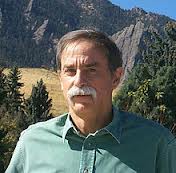
David Wineland, an experimental physicist at the National Institute for Standards and Technology (NIST) in Boulder, Colorado, is one of the leading researchers in the field of trapped ions: that is, the study of how positively-charged ions (i.e. atoms stripped of one or more electrons) may be trapped, cooled, and manipulated. This field shares many similarities with experiments on neutral atoms (laser cooling, for example, is just as useful for ions as it is for neutral atoms), but also has a number of significant differences. The most important difference that distinguishes ions from atoms is, obviously enough, the fact that ions have a non-zero net electrical charge. This has two very important consequences.
Trapped ions: trapping and interactions
 |
| A string of trapped ions (red dots) lined up in a Paul trap can be imaged with a tightly-focused laser beam and CCD camera. Image credit: Rainer Blatt experimental group, University of Innsbruck. |
Applying an electric field to an ion produces a force on the ion: positive ions are drawn in the direction of the field. [In contrast, applying an electric field to a neutral atom changes the ‘shape’ of the atom slightly, since the positively-charged nucleus and negatively-charged electron cloud are drawn in opposite directions, but produces no net force.] Consequently, whereas traps for neutral atoms must rely on combinations of laser light and magnetic fields, ions can be trapped just by electric fields. Most of the recent trapped-ion experiments use some variation on the Paul trap (a.k.a. the quadrupole ion trap) which uses a combination of static (DC) and oscillating (AC) electric fields to trap ions along a 1-dimensional line.
Tuesday, October 30, 2012
The 2012 Nobel Prize in Physics: The background
[The following is a guest post from Simon Thwaite. Simon recently completed his doctorate in the subdepartment of Atomic & Laser Physics at the University of Oxford. He is currently in the limbo that lies between the submission of a doctoral thesis and its examination, and is looking forward to taking up a postdoctoral research fellowship in the Theoretical Nanophysics group at the Ludwig Maximilian University, Munich, from January 2013.
In Part 1 of this post he discusses the foundations of the field of atomic, molecular, and optical physics, and describes the process of laser cooling, an experimental technique for cooling atoms to extremely low temperatures. This technique forms the foundation for many of the current experiments in the field.
In Part 2 of this post he describes the experiments carried out by Haroche and Wineland, and discusses the possible applications and future directions of their work.]
The 2012 Nobel Prize in Physics: score one more for AMO physics
Those with their finger on the physics pulse will have seen that the 2012 Nobel Prize in Physics was recently awarded jointly to Serge Haroche and David J. Wineland for their development of "ground-breaking experimental methods that enable measuring and manipulation of individual quantum systems". This announcement raises a number of questions for physicists and physics followers alike: what is meant by an ‘individual quantum system’, and why would anyone want to measure and manipulate such a thing? What kind of experiments do Haroche and Wineland do, and what new scientific and technological possibilities does their research unlock? And -- last but not least -- will Prof. Wineland be involved in the imminent month of Movember? Because if he is, everyone else might as well just go home right now.
Atomic, molecular, and optical physics: a brief history
The research of Haroche and Wineland falls within the field of atomic, molecular, and optical (AMO) physics, which studies how particles of matter (atoms, ions, and molecules) interact both with one another and with particles of light (photons: see figure), and how these interactions can be controlled and exploited to engineer systems of particular scientific or technological interest. AMO physics is currently a highly active and dynamic area of research, with applications which range from questions of fundamental scientific interest (e.g. is it possible that the fine structure constant is actually changing slowly with time?) through to real-world technologies (e.g. the development of ultra-precise atomic clocks for the definition of universal time and frequency standards). It has also enjoyed somewhat of a Golden Age in recent years, with the 2012 Nobel Prize in Physics being the third in the last 15 years (after 1997 and 2001) to be awarded for work in the field.
The physical theory that governs the world in the ultra-small regime of atoms, molecules, and photons is the theory of quantum mechanics, which describes both the behavior of these individual quantum systems and the way in which they interact. The roots of AMO physics can thus be traced back to the early part of the 20th century, when quantum mechanics was developed in the course of the search for a better understanding of such phenomena as the radiation emitted by hot objects and the internal structure of atoms.
Building on the theory of quantum mechanics, the state of atomic physics improved at a breathtaking pace throughout the first half of the 20th century. In contrast, research into the ‘optical’ part of AMO physics progressed at a more sedate pace. While much of the required theoretical knowledge already existed – the wave theory of light and the electronic structure of atoms both being well-understood by this point – rapid progress in any field requires interaction between theory and experiment, and the absence of any technology that could produce a focused, powerful, and wavelength-specific (i.e. single-colour) source of light severely restricted the sophistication of possible atom-light experiments.
Laser cooling: the beginning of the Golden Age
These problems could be largely nullified if only the atoms in the gas could be slowed down, or even brought to a complete stop. The great discovery of the 1980s and early 1990s was that this can be achieved by using laser light of a carefully-selected frequency to manipulate the atoms in the gas. Like many of the best achievements in science, the basic idea is both simple and elegant: a rapidly-moving atom is gradually slowed down by bouncing a stream of photons off it, one after another. Although each photon takes only a small amount of momentum away from the atom, the absorption and re-emission of a photon takes place in less than a microsecond, so that a single atom can scatter over a million photons every second. Consequently, an atom can be slowed down from a speed of several hundred metres per second (corresponding to room temperature) to a near-complete standstill in only a few thousandths of a second. These laser-cooled atoms -- which are at a far lower temperature than anything found in nature, even in the deepest depths of outer space -- can now be measured, probed, and further manipulated with an extremely high degree of accuracy.
[If you'd like to try out laser-cooling for yourself, the University of Colorado at Boulder has made a fantastic series of interactive Java applets that describe the process very well.]
In Part 1 of this post he discusses the foundations of the field of atomic, molecular, and optical physics, and describes the process of laser cooling, an experimental technique for cooling atoms to extremely low temperatures. This technique forms the foundation for many of the current experiments in the field.
In Part 2 of this post he describes the experiments carried out by Haroche and Wineland, and discusses the possible applications and future directions of their work.]
 |
2012 Nobel Laureates in Physics Serge Haroche (left) and David J. Wineland (photo credit: CNRS, NIST).
|
The 2012 Nobel Prize in Physics: score one more for AMO physics
Atomic, molecular, and optical physics: a brief history
 |
A rough sketch of an atom (not actual size).
The electrons orbiting the nucleus are only
permitted to occupy a certain discrete set of
energy levels.
|
Building on the theory of quantum mechanics, the state of atomic physics improved at a breathtaking pace throughout the first half of the 20th century. In contrast, research into the ‘optical’ part of AMO physics progressed at a more sedate pace. While much of the required theoretical knowledge already existed – the wave theory of light and the electronic structure of atoms both being well-understood by this point – rapid progress in any field requires interaction between theory and experiment, and the absence of any technology that could produce a focused, powerful, and wavelength-specific (i.e. single-colour) source of light severely restricted the sophistication of possible atom-light experiments.
This state of affairs changed drastically with the invention of the laser in the early 1960s. Developing out of radar and microwave research carried out during the Second World War at Bell Laboratories, lasers provided a light that was radically different from anything seen before: in addition to containing only a single pure wavelength, laser light is well collimated (i.e. forms a well-defined beam) and can easily be millions of times more intense than any other light source. At a stroke, the door was opened to a whole range of possible new atom-light experiments, ushering in a new era in the discipline of atomic, molecular and optical physics.
 |
Laser light can be viewed as either a travelling electromagnetic wave (left) or a stream of photons (right). |
Laser cooling: the beginning of the Golden Age
One particularly striking demonstration of the possibilities that laser light provides for controlling and manipulating atoms has been the development of laser cooling: using tightly-focused beams of laser light to slow down, or cool, a collection of atoms in a gas. Developed throughout the 1980s and recognized with the 1997 Nobel Prize in Physics, laser cooling is today ubiquitous in a wide range of AMO physics experiments, and forms the foundation for the fertile subfield of ultracold atoms.
But you thought lasers could only heat things up, or burn holes in them? Then read on.
The atoms in a gas at room temperature move about very rapidly (their speed depends on the temperature of the gas, but in any case is of the order of several hundred metres per second). Now imagine that you’re an experimental physicist, and your goal is to manipulate and interact with these atoms in some kind of precise, controlled way -- for example, you might want to carry out some spectroscopy on them in order to measure the exact frequencies of light that this atomic species absorbs and emits. In this case, working with a ‘hot’ gas of rapidly-moving atoms is far from ideal -- in fact, it’s a complete disaster. Since the atoms are moving reasonably quickly, the radiation they absorb and emit is subject to a significant Doppler shift, making precise frequency measurements impossible. Further, the atoms collide both with one another and with the walls of their container, and these collisions lead to an additional ‘smearing out’ of the frequencies emitted or absorbed by each atom.
These problems could be largely nullified if only the atoms in the gas could be slowed down, or even brought to a complete stop. The great discovery of the 1980s and early 1990s was that this can be achieved by using laser light of a carefully-selected frequency to manipulate the atoms in the gas. Like many of the best achievements in science, the basic idea is both simple and elegant: a rapidly-moving atom is gradually slowed down by bouncing a stream of photons off it, one after another. Although each photon takes only a small amount of momentum away from the atom, the absorption and re-emission of a photon takes place in less than a microsecond, so that a single atom can scatter over a million photons every second. Consequently, an atom can be slowed down from a speed of several hundred metres per second (corresponding to room temperature) to a near-complete standstill in only a few thousandths of a second. These laser-cooled atoms -- which are at a far lower temperature than anything found in nature, even in the deepest depths of outer space -- can now be measured, probed, and further manipulated with an extremely high degree of accuracy.
 |
The process of laser cooling: by arranging a set of lasers such that they remove momentum from the rapidly-moving atoms in a room-temperature gas, clouds of up to a few tens of millions of atoms can be cooled down to temperatures of less than a millionth of a degree above absolute zero . |
[If you'd like to try out laser-cooling for yourself, the University of Colorado at Boulder has made a fantastic series of interactive Java applets that describe the process very well.]
Together with the invention of related techniques for trapping clouds of laser-cooled atoms using combinations of laser light and magnetic fields, the development of laser cooling stimulated a frenzy of new activity in atomic, molecular, and optical physics. Since the early 1990s, the level of experimental control in cold-atom experiments has progressed to the point where it is now routine to isolate, trap, and cool either individual atoms, or clouds of up to a few tens of millions of atoms, to temperatures of a few hundreds of nanoKelvin (billionths of a degree above absolute zero) in a controlled and repeatable fashion. These new experimental capabilities have found applications in a diverse range of topics, which span all facets of atomic, molecular, and optical physics. Two such topics in which laser cooling plays an integral role – namely, the interaction of laser-cooled atoms with light trapped between two very small mirrors, and the interaction of light with laser-cooled ions trapped by rapidly-oscillating electric fields – are those in which the Nobel-winning research of Serge Haroche and David Wineland lies.
[Part 2, coming soon...]
[Part 2, coming soon...]
Monday, October 1, 2012
The human machine: (thermo)dynamics of muscles
The previous post in this series can be found here.
The following is a guest post from Björn Malte Schäfer
(blog: cosmology question of the week, personal webpage)
The following is a guest post from Björn Malte Schäfer
(blog: cosmology question of the week, personal webpage)
How do muscles work?
Physics students learn the definition of work and mechanical energy in the first course on classical mechanics. Mechanical work is performed when a test body is moved against a force, and the work performed is equal to the (vectorial) product of the distance covered times the force, if it stays constant, otherwise you would have to evaluate an integral. If the test particle is stationary, no work is performed. But what what happens when you hold a heavy object with your arm? Even if you don't move the arm and don't perform any work from a physical point of view, it proves exhausting and after a while the arm starts aching. You at least have the feeling of having performed work, although this contradicts the physical definition of work.Mechanical vs. molecular engines
What's wrong here? Are muscles different compared to engines? Clearly, there's a contradiction. It turns out that this example can be explained via the mechanism of molecular engines, which work very differently compared to the mechanical engines we're familiar with. And one needs to understand a bit of non-equilibrium thermodynamics!Actin and myosin proteines
Muscles consist of two proteins called actin and myosin. Actin is in fact a very old "invention" of Nature, it is almost identical in yeast and in humans, and serves the purpose of cytokinesis, i.e. the separation of cells as well as locomotion. It consists of amino-acids and has a helical shape. Myosin is a protein that is able to change its shape under the influence of adenosin-triphosphate (ATP). It resembles a q-tip with a head that can carry out a nodding movement. The energy for changes to myosin's shape is provided by consuming an ATP molecule and dissociating it into adenosin-diphosphate (ADP). Fresh ATP is generated in mitochondria, which are small cellular organelles, by oxidation of sugars. |
| illustration of the actin-myosin protein assembly inside muscle cells |
The actin-myosin engine
The actin-myosin engine proceeds by 5 steps:Monday, September 3, 2012
Higgs: A view from the moment of discovery!
[Note from Shaun: When Mikko wrote us a guest post about the Higgs discovery he also gave me a short note he had written on the day CMS first opened their 2012 box and looked at the Higgs-relevant data. I decided to save that note for a rainy day. Today, is that rainy day (literally, in Helsinki). What follows is more or less exactly what Mikko wrote down the evening that he and about 100 other people first learned that they really had discovered an entirely new fundamental (probably) particle. The rest of us couldn't be there in that room, but we can read about it now!]
**** Do not open before July 9 *****
Recollections of a Higgs discovery
It's not official yet, and will not be for another three weeks, but you could say Higgs was finally discovered today, on Friday, 15th of June, 2012. More than fifty years of searching, and there it is, at 125 GeV, just like the first hints last December indicated.
The big occasion was the unblinding of the 2012 data set at a Higgs meeting held at CERN at 15:00 hours on Friday evening. The meeting venue, the non-descript Building 222 better known as the Filtration Plant, was stacked with CMS physicists, with half of the crowd sitting on the floor or leaning against the back wall. The air was dense from expectation, and immensely hot from the mass of people and failing ventilation.
Everybody was appropriately informed of the formal proceedings of the day: the slides would not be posted on the web, no recordings of the video meeting would be allowed (except an official one by the CMS Outreach Team), and nothing shall be leaked outside the collaboration after the meeting. Only the highest level of CMS management had seen all the results before, at a special preview held at 11am in the morning.
For the uninitiated, I should probably explain what the unblinding is all about. Scientists are intimately aware of unconcious biases in analysis, when the stakes are high and the statistics are low. Therefore, it is considered good practice to not look into the signal region before fixing the analysis procedure and cuts. The expected background in the signal region is estimated using side bands, and the analysis only proceeds to look in the signal region, the "box", when those side bands are found to be sufficiently well understood.
The Higgs group had agreed that nobody would look into the signal region of 2012 data before today (or yesterday evening really, to allow some time for analyzers to prepare their talks). The previous week was spent by review committees scrutinizing each of the analyses and making sure all the systematics were thought of and no obvious mistakes would remain. Only the analyses given official green light would be allowed to open the box, and the whole collaboration was invited to join the event.
A significant fraction of the three thousand collaborators apparently did indeed join, most of them remotely. From the first few minutes it was clear that the video meeting system was creaking and was barely holding the traffic. The outside world could hear the audio, and we could hear some of them (despite frequent reminders to mute), but the video feed was apparently stalling. With no slides posted, the people in the videoland were more or less blind.
All the more reason to feel privileged to be at CERN to listen to the talks in person.
The first three talks were strategically ordered to go from the channel with the worst mass resolution and lowest expected sensitivity to the one with best resolution and expected sensitivity. The HWW (Higgs decaying into two W bosons) analysis got the honor to be the first messenger.
After a bit of a jumpy start with switching lights on and off for better contrast on the video projector, trying to transmit slides outside CERN and accidentally dropping the network connection, the talk finally got up to speed. Several slides showing impressive agreement between data and simulation covered the sidebands before moving on to signal regions, with quite visible excesses. The bottom line: a little more than a three sigma excess with combined 2011(5/fb)+2012(3/fb) data, precisely in agreement with the standard model expectation for a 125 GeV Higgs. Hey, this starts to look quite promising!
After a few more minutes of more and less technical questions from the collaborators we turned to the Hgammagamma (Higgs decaying into two photons) channel. The talk was given by a young Chinese graduate student from MIT, who'd obviously absorbed the American style of putting a bit of drama into the talks. With skill she had the collaboration holding their breath waiting to see the new limit plots... with a gigantic peak and a local excess of more than 4 sigma at 125 GeV when combined with 2011 data.
At that point I had to fight a bit breaking into tears. Those two channels alone meant that we'd have to be above the 5 sigma discovery limit already. It would mean we had discovered the Higgs. After 50 years of searching. Us, here.
Ok, back to sobering up a bit. The signal was much stronger than expected from standard model, which means we had either got very lucky, or that this could be a non-standard-model Higgs. All the better, we might have more to discover later in the year. The measurements from different subcategories of photons pairs and from 2011 and 2012 looked all perfectly consistent so there was no hint of a measurement error.
The last of the big three talks was ZZ4l (Higgs decaying into two Z bosons, which in turn decay into four leptons). This is the ultimate channel with very little background so you could even claim with good probability that some individual events are from a Higgs boson decay, unlike in the background dominated HWW and Hgammagamma channels. The expectations were already high from the two previous talks, and the results certainly did not disappoint. Around half a dozen nicely clustered events right at 125 GeV, just like the standard model predicted.
It's interesting to note that improvements to the analysis, like Particle Flow based lepton isolation and recovery of photons radiated off the Z bosons, had both improved sensitivity and caused the secondary peak seen at 119 GeV in 2011 to disappear. The updated results combined with 2012 statistics made a very convincing case, racking up another 3 sigma or so.
The main trio was followed by a fourth talk on VH (Higgs produced in association with a vector boson, i.e. Z or W), which however had not yet been granted green light to open the box. Nevertheless, the analysts had made nice improvements to the analysis, gaining 50% more sensitivity out of the 2011 data, and showing a small excess consistent with standard model Higgs. A planned fifth talk on Higgs decaying into two tau leptons was postponed pending more checks, as was appropriate. The background checks before opening the box were clearly taken seriously.
Overall it was quite a tour-de-force, with all channels lining up in unison. This is still not all, because the analyses used only the first 3.9/fb of 2012 data collected until June 8, and in most cases even less. With 5.6/fb already in the can today and three more days to go to reach above 6/fb, the analyses will likely have about 50% more integrated luminosity for ICHEP. This might be enough to take some channels already above 5 sigma by themselves.
In the short summary the Higgs conveners reminded everybody that this is really a result by everybody in the collaboration, not just the Higgs group: thousands of people had contributed in building, maintaining and running the detectors, writing reconstruction software, calibrating the detectors, checking the data etc. The final analysis was only the tip of a large iceberg. And the work was not yet over, there was still plenty to do before presenting the results in Melbourne, Australia on July 9.
A final warning was given before people departed the room: smiles should be subdued and no champagne bottles should be popped in the cafeteria; there were filming crews outside that had not been allowed in the meeting room, and they had vowed to film the expressions on the people as they came out. We should not let the world know just yet ;)
At CERN in Geneva, Switzerland
June 15,
**** Do not open before July 9 *****
Recollections of a Higgs discovery
It's not official yet, and will not be for another three weeks, but you could say Higgs was finally discovered today, on Friday, 15th of June, 2012. More than fifty years of searching, and there it is, at 125 GeV, just like the first hints last December indicated.
The big occasion was the unblinding of the 2012 data set at a Higgs meeting held at CERN at 15:00 hours on Friday evening. The meeting venue, the non-descript Building 222 better known as the Filtration Plant, was stacked with CMS physicists, with half of the crowd sitting on the floor or leaning against the back wall. The air was dense from expectation, and immensely hot from the mass of people and failing ventilation.
Everybody was appropriately informed of the formal proceedings of the day: the slides would not be posted on the web, no recordings of the video meeting would be allowed (except an official one by the CMS Outreach Team), and nothing shall be leaked outside the collaboration after the meeting. Only the highest level of CMS management had seen all the results before, at a special preview held at 11am in the morning.
For the uninitiated, I should probably explain what the unblinding is all about. Scientists are intimately aware of unconcious biases in analysis, when the stakes are high and the statistics are low. Therefore, it is considered good practice to not look into the signal region before fixing the analysis procedure and cuts. The expected background in the signal region is estimated using side bands, and the analysis only proceeds to look in the signal region, the "box", when those side bands are found to be sufficiently well understood.
The Higgs group had agreed that nobody would look into the signal region of 2012 data before today (or yesterday evening really, to allow some time for analyzers to prepare their talks). The previous week was spent by review committees scrutinizing each of the analyses and making sure all the systematics were thought of and no obvious mistakes would remain. Only the analyses given official green light would be allowed to open the box, and the whole collaboration was invited to join the event.
A significant fraction of the three thousand collaborators apparently did indeed join, most of them remotely. From the first few minutes it was clear that the video meeting system was creaking and was barely holding the traffic. The outside world could hear the audio, and we could hear some of them (despite frequent reminders to mute), but the video feed was apparently stalling. With no slides posted, the people in the videoland were more or less blind.
All the more reason to feel privileged to be at CERN to listen to the talks in person.
The first three talks were strategically ordered to go from the channel with the worst mass resolution and lowest expected sensitivity to the one with best resolution and expected sensitivity. The HWW (Higgs decaying into two W bosons) analysis got the honor to be the first messenger.
After a bit of a jumpy start with switching lights on and off for better contrast on the video projector, trying to transmit slides outside CERN and accidentally dropping the network connection, the talk finally got up to speed. Several slides showing impressive agreement between data and simulation covered the sidebands before moving on to signal regions, with quite visible excesses. The bottom line: a little more than a three sigma excess with combined 2011(5/fb)+2012(3/fb) data, precisely in agreement with the standard model expectation for a 125 GeV Higgs. Hey, this starts to look quite promising!
After a few more minutes of more and less technical questions from the collaborators we turned to the Hgammagamma (Higgs decaying into two photons) channel. The talk was given by a young Chinese graduate student from MIT, who'd obviously absorbed the American style of putting a bit of drama into the talks. With skill she had the collaboration holding their breath waiting to see the new limit plots... with a gigantic peak and a local excess of more than 4 sigma at 125 GeV when combined with 2011 data.
At that point I had to fight a bit breaking into tears. Those two channels alone meant that we'd have to be above the 5 sigma discovery limit already. It would mean we had discovered the Higgs. After 50 years of searching. Us, here.
Ok, back to sobering up a bit. The signal was much stronger than expected from standard model, which means we had either got very lucky, or that this could be a non-standard-model Higgs. All the better, we might have more to discover later in the year. The measurements from different subcategories of photons pairs and from 2011 and 2012 looked all perfectly consistent so there was no hint of a measurement error.
The last of the big three talks was ZZ4l (Higgs decaying into two Z bosons, which in turn decay into four leptons). This is the ultimate channel with very little background so you could even claim with good probability that some individual events are from a Higgs boson decay, unlike in the background dominated HWW and Hgammagamma channels. The expectations were already high from the two previous talks, and the results certainly did not disappoint. Around half a dozen nicely clustered events right at 125 GeV, just like the standard model predicted.
It's interesting to note that improvements to the analysis, like Particle Flow based lepton isolation and recovery of photons radiated off the Z bosons, had both improved sensitivity and caused the secondary peak seen at 119 GeV in 2011 to disappear. The updated results combined with 2012 statistics made a very convincing case, racking up another 3 sigma or so.
The main trio was followed by a fourth talk on VH (Higgs produced in association with a vector boson, i.e. Z or W), which however had not yet been granted green light to open the box. Nevertheless, the analysts had made nice improvements to the analysis, gaining 50% more sensitivity out of the 2011 data, and showing a small excess consistent with standard model Higgs. A planned fifth talk on Higgs decaying into two tau leptons was postponed pending more checks, as was appropriate. The background checks before opening the box were clearly taken seriously.
Overall it was quite a tour-de-force, with all channels lining up in unison. This is still not all, because the analyses used only the first 3.9/fb of 2012 data collected until June 8, and in most cases even less. With 5.6/fb already in the can today and three more days to go to reach above 6/fb, the analyses will likely have about 50% more integrated luminosity for ICHEP. This might be enough to take some channels already above 5 sigma by themselves.
In the short summary the Higgs conveners reminded everybody that this is really a result by everybody in the collaboration, not just the Higgs group: thousands of people had contributed in building, maintaining and running the detectors, writing reconstruction software, calibrating the detectors, checking the data etc. The final analysis was only the tip of a large iceberg. And the work was not yet over, there was still plenty to do before presenting the results in Melbourne, Australia on July 9.
A final warning was given before people departed the room: smiles should be subdued and no champagne bottles should be popped in the cafeteria; there were filming crews outside that had not been allowed in the meeting room, and they had vowed to film the expressions on the people as they came out. We should not let the world know just yet ;)
At CERN in Geneva, Switzerland
June 15,
Monday, August 6, 2012
A look at science from another side of the trench
[Note from Shaun: The following is a guest post from Claudia Mignone. As you will learn from the post, Claudia is a scientist turned science writer and she shares below her thoughts on the divide between scientists and science journalism. Her past lives on both sides of this divide allow her to also see both perspectives of a world that can sometimes descend into acrimony. Enjoy... (all credit/blame for the image captions is my own to bear)]
I am an astronomer/cosmologist by training, and have been happily working as a science writer for almost three years now. In this post, I will explore the borderline that divides the people in the “trenches”, who are actively conducting research and producing scientific knowledge and results (what we like to call the “scientific community”, whatever the term really means), and everyone else who has an interest in the outcome of such research (let's call them “the public”). The borderline is quite an interesting grey area. Its width may vary significantly and continuously on the basis of a large number of factors and it remains partly unexplored by many. As someone who has spent some time working on both sides of this blurred region, I thought I'd share some thoughts that might be useful, particularly to the folks who are still locked in the “trenches”.
Before I start doing so though, let me just add some sort of disclaimer: I don't mean to dispense any sort of “wisdom” here. All of my thoughts and observations are based on my own personal experience (plus that of many colleagues/fellow scientists that I've encountered along the way) but are by no means of a general nature. It is very well possible that others have gone through quite different paths and might disagree with the view that I developed along mine. I haven't conducted any study (neither thorough or superficial) on any of the subjects I'll mention – although I'd love to do so in the future! – so I won't draw any conclusions, because I haven't reached any – yet. But maybe I'll try to propose some advice here and there. Feel free to take them. Or not.
 |
| Heidelberg! A university here sometimes awards PhD's to starving cosmologists. (Photo by Claudia) |
I am an astronomer/cosmologist by training, and have been happily working as a science writer for almost three years now. In this post, I will explore the borderline that divides the people in the “trenches”, who are actively conducting research and producing scientific knowledge and results (what we like to call the “scientific community”, whatever the term really means), and everyone else who has an interest in the outcome of such research (let's call them “the public”). The borderline is quite an interesting grey area. Its width may vary significantly and continuously on the basis of a large number of factors and it remains partly unexplored by many. As someone who has spent some time working on both sides of this blurred region, I thought I'd share some thoughts that might be useful, particularly to the folks who are still locked in the “trenches”.
Before I start doing so though, let me just add some sort of disclaimer: I don't mean to dispense any sort of “wisdom” here. All of my thoughts and observations are based on my own personal experience (plus that of many colleagues/fellow scientists that I've encountered along the way) but are by no means of a general nature. It is very well possible that others have gone through quite different paths and might disagree with the view that I developed along mine. I haven't conducted any study (neither thorough or superficial) on any of the subjects I'll mention – although I'd love to do so in the future! – so I won't draw any conclusions, because I haven't reached any – yet. But maybe I'll try to propose some advice here and there. Feel free to take them. Or not.
Monday, July 9, 2012
Why do galaxies rotate?
[Note from Shaun: The following is a guest post from cosmologist Bjoern Malte Schaefer, who works at the University of Heidelberg. He also writes at the blog, Cosmology Question of the Week, which, although aimed at undergraduate and postgraduate students of cosmology, is worth a look for everyone.]
Why do galaxies rotate?
Galaxies rotate, every child knows that. Looking at the images of grand spiral galaxies it is quite suggestive to think how all the stars and gas that make up a galaxy all move in a more or less orderly fashion about the galaxy's centre. However, when we think about mechanisms through which galaxies can acquire angular momentum the matter seems very obscure: how do they start rotating in the first place?
The formation of cosmic structure, including galaxies and the larger clusters and superclusters in which they are embedded, is a fluid mechanical phenomenon, where gravity is the only force acting on the distribution of matter on large scales. It is in fact gravity that amplified the tiny fluctuations present in the primordial distribution of matter that filled the early Universe (matter here means mostly cold dark matter) and caused them to evolve into the large-scale structure that we observe in the present Universe. These tiny fluctuations grew by self-gravity: a region in the matter distribution that is slightly denser than its surroundings generates a gravitational pull and accumulates more matter, hence its density increases with time.
At first sight it is very difficult to imagine how gravity could introduce rotation. After all, on the scales of cosmic structures, gravity is well approximated by the scalar Newtonian potential, which is parity invariant and does not possess any chirality: At which point would a galaxy in the forming decide whether it should rotate clockwise or counterclockwise? The answer to this lies in a process called tidal shearing, which consists in a misalignment between the tidal forces (the second derivatives of the gravitational field) and the moment of inertia of the protogalaxy (the second moments of the matter distribution). The meaning of these technical terms can be explained quite easily: Imagine a curling stone sliding along the sheet, where the ice surface on its left side is a bit smoother compared to the right side. The stone will be set into clockwise rotation by this difference in force. For a protogalaxy, it is the variation in gravitational force moving the galaxy along that introduces rotation, and is responsible for the galaxy's angular momentum.
 |
| Image illustrating why there is a relationship between angular momentum direction and inclination angle (and hence the apparent shape of a galaxy) |
Why do galaxies rotate?
Galaxies rotate, every child knows that. Looking at the images of grand spiral galaxies it is quite suggestive to think how all the stars and gas that make up a galaxy all move in a more or less orderly fashion about the galaxy's centre. However, when we think about mechanisms through which galaxies can acquire angular momentum the matter seems very obscure: how do they start rotating in the first place?
The formation of cosmic structure, including galaxies and the larger clusters and superclusters in which they are embedded, is a fluid mechanical phenomenon, where gravity is the only force acting on the distribution of matter on large scales. It is in fact gravity that amplified the tiny fluctuations present in the primordial distribution of matter that filled the early Universe (matter here means mostly cold dark matter) and caused them to evolve into the large-scale structure that we observe in the present Universe. These tiny fluctuations grew by self-gravity: a region in the matter distribution that is slightly denser than its surroundings generates a gravitational pull and accumulates more matter, hence its density increases with time.
At first sight it is very difficult to imagine how gravity could introduce rotation. After all, on the scales of cosmic structures, gravity is well approximated by the scalar Newtonian potential, which is parity invariant and does not possess any chirality: At which point would a galaxy in the forming decide whether it should rotate clockwise or counterclockwise? The answer to this lies in a process called tidal shearing, which consists in a misalignment between the tidal forces (the second derivatives of the gravitational field) and the moment of inertia of the protogalaxy (the second moments of the matter distribution). The meaning of these technical terms can be explained quite easily: Imagine a curling stone sliding along the sheet, where the ice surface on its left side is a bit smoother compared to the right side. The stone will be set into clockwise rotation by this difference in force. For a protogalaxy, it is the variation in gravitational force moving the galaxy along that introduces rotation, and is responsible for the galaxy's angular momentum.
Wednesday, July 4, 2012
A Higgs Hunter's story...
[Note from Shaun: Here is Higgs hunter Mikko Voutilainen's account of the recent search for the Higgs. You can find the teaser to this post here. And my own, partially cynical, but ultimately upbeat, account of Higgs-things, here.]
Here it is, finally
[I assume the readers of this blog are somewhat familiar with the Higgs boson; if not, there's a nice summary on the CMS pages here]
So, this is the follow-up to the teaser I wrote a week ago. Now that everybody knows we found a Higgs boson at \(125.3\pm 0.6\) GeV, I'm free to talk about our finding, what it means and how we got there. Note the intentional use of 'a' Higgs there: although we, beyond reasonable doubt (less than one in a million chance of an error, to be precise), found a new particle, it's not 100% sure yet if it's *the* Higgs boson predicted by the standard model, or one of its many twins predicted by the hundreds of theories out there. There's even a tiny chance of it being an altogether different particle yet.
We actually already know a fair deal about this new particle besides the rather impressively precise estimate of its mass: it seems to be produced at a rate that matches the standard model prediction within about 20% uncertainty, it decays into bosons (W, Z and photon) and fermions (b-quarks and tau-leptons) roughly in the ratios predicted by the standard model, and in particular it decays into W and Z bosons in the ratio predicted by the standard model. The last point is rather important, because the Higgs mechanism, and the Higgs boson along with it, was invented to give mass to the W and Z bosons, and leave the photon massless. This also fixes the ratio of the decay rates to W and Z. If the new particle didn't decay into Z's and W's in just the right ratio, it couldn't be the Higgs boson we predicted.
We've also had a stab at determining the more abstract properties of the particle such as a quantum number called parity, but the statistics are low and the results still inconclusive. Predictions say we should be able to tell by the end of the current run, when we've collected 2--3 times the amount of data we have now. At this point we should also have more precise determination of the particle's decay rates in all the different channels, in order to gain more confidence in calling the particle a Higgs boson or something else.
So, is this the end, or the beginning of something new? I'm really hoping for the latter. If the new particle turns out to be 'just' the standard model Higgs boson and there's nothing new to be found, that would be fairly boring. If instead it's a Higgs twin, we may have just opened a window into a new landscape of particles.
At the moment it's too early to tell for sure, but there are a few interesting features to the way the new particle decays. It seems to decay into photons more often than expected, and to tau-leptons less often than expected. Taking all the decays to fermions together, they only seem to add up to about half of the rate predicted by the standard model, albeit with an error of about 50% as well. That coincidence is causing a bit of excitement nevertheless.
It might not be too bad for the standard model, though, it could just indicate that it's 'non-minimal'. While the Higgs coupling to W and Z is pretty tightly constrained, all the other particle masses are more of an ad-hoc addition to the theory, and there's some freedom to adjust how these particles couple to the Higgs boson without breaking everything else. Another good example of something that would require a 'non-minimal' standard model are the neutrino masses, which in the simplest expectation are exactly zero. We now know they are not zero, although we've still to nail down exactly how much they weigh (it's very very little in any case).
What for me was most interesting in this was to see first-hand how things have evolved towards a big discovery. Things started rolling about six months ago, when the first results from LHC Higgs boson searches were presented last December. Back then both ATLAS and CMS saw a hint of a Higgs at 125 GeV, with about 2-2.5 sigma statistical confidence. If you were a Higgs-believer, you could have given the signal more than 95% chance of being true.
After December it was decided that we wouldn't look at the 2012 data in the signal region before we had enough to confirm or refute the hint seen in 2011. This process is called blinding, and its important for making sure the analyzers are not unconciously affected by their prior expectations. Blinding is also one of the reasons we've tried to keep a lid on the results until today's seminar so that the experiments would not affect each other's findings between opening their signal box opening and presenting the final results. I think we were fairly successful in the end, although rumors started circulating on the blogs within days, and by yesterday almost every major newspaper (including Nature) had run a story on Higgs.
Between opening the signal box and seeing the first evidence of a new particle there was a whole lot of work going on for 2--3 weeks to prepare for ICHEP. The analyses added around 50% more data, the particle properties were studied in more detail, the CMS management had regular meetings with both ATLAS and CERN directors, people were working day and night to scrutinize the results, prepare documentation, etc. The final days were spent polishing plots, rehearsing presentations and fine-tuning press releases. Although I didn't happen to be at CERN during that period (I did attend the signal box opening in the beginning, though), I could at least participate through the almost daily video meetings and by keeping my own small piece of CMS running (I'm responsible for a team calibrating jets).
Just two days prior to the seminar there was also a presentation of the Tevatron Higgs results at Fermilab. The Tevatron people had done a superb job in squeezing every last bit of sensitivity out of their data and fell just a hair's width short of claiming evidence for the Higgs (they got 2.94 sigma by the most optimistic count, and needed 3.0). The Tevatron experiments collected data for ten years before shutting down last summer, and have the same amount of data (10 fb-1) available for analysis as the LHC experiments now. The lower collision energy of the Tevatron, 2 TeV versus 8 TeV at LHC, means roughly ten times less Higgs bosons are produced, but they still have better sensitivity in one single channel, the Higgs decaying into two b-quarks. I was watching that live on video, too, cheering for my old colleagues (I did my PhD on D0, one of the two experiments at the Tevatron).
And then, finally, today we had a chance to see how our colleagues and rivals at ATLAS were doing with their Higgs search. According to blog rumors, newspaper leaks and sensitivity estimate just a tad behind CMS, but never far. As it turned out, both CMS and ATLAS came up with the same significance in the end, within 0.1 sigma precision. Both experiments have now just made it to the 5-sigma milestone, and it's pretty clear that the signal has been effectively confirmed by at least three experiments (counting D0 and CDF together as a single Tevatron experiment).
P.S. I wrote a lengthy story about the box opening the same evening when I was at CERN, and stored it on a time capsule on my e-mail account. I'm not sure if it's interesting anymore, but at least I shouldn't be breaking any confidentiality rules by releasing it. [Shaun speaking: I now have this item in my possession, so if anyone wants to see it please let me know and I will upload it in a few days.]
Here it is, finally
[I assume the readers of this blog are somewhat familiar with the Higgs boson; if not, there's a nice summary on the CMS pages here]
So, this is the follow-up to the teaser I wrote a week ago. Now that everybody knows we found a Higgs boson at \(125.3\pm 0.6\) GeV, I'm free to talk about our finding, what it means and how we got there. Note the intentional use of 'a' Higgs there: although we, beyond reasonable doubt (less than one in a million chance of an error, to be precise), found a new particle, it's not 100% sure yet if it's *the* Higgs boson predicted by the standard model, or one of its many twins predicted by the hundreds of theories out there. There's even a tiny chance of it being an altogether different particle yet.
We actually already know a fair deal about this new particle besides the rather impressively precise estimate of its mass: it seems to be produced at a rate that matches the standard model prediction within about 20% uncertainty, it decays into bosons (W, Z and photon) and fermions (b-quarks and tau-leptons) roughly in the ratios predicted by the standard model, and in particular it decays into W and Z bosons in the ratio predicted by the standard model. The last point is rather important, because the Higgs mechanism, and the Higgs boson along with it, was invented to give mass to the W and Z bosons, and leave the photon massless. This also fixes the ratio of the decay rates to W and Z. If the new particle didn't decay into Z's and W's in just the right ratio, it couldn't be the Higgs boson we predicted.
We've also had a stab at determining the more abstract properties of the particle such as a quantum number called parity, but the statistics are low and the results still inconclusive. Predictions say we should be able to tell by the end of the current run, when we've collected 2--3 times the amount of data we have now. At this point we should also have more precise determination of the particle's decay rates in all the different channels, in order to gain more confidence in calling the particle a Higgs boson or something else.
So, is this the end, or the beginning of something new? I'm really hoping for the latter. If the new particle turns out to be 'just' the standard model Higgs boson and there's nothing new to be found, that would be fairly boring. If instead it's a Higgs twin, we may have just opened a window into a new landscape of particles.
At the moment it's too early to tell for sure, but there are a few interesting features to the way the new particle decays. It seems to decay into photons more often than expected, and to tau-leptons less often than expected. Taking all the decays to fermions together, they only seem to add up to about half of the rate predicted by the standard model, albeit with an error of about 50% as well. That coincidence is causing a bit of excitement nevertheless.
It might not be too bad for the standard model, though, it could just indicate that it's 'non-minimal'. While the Higgs coupling to W and Z is pretty tightly constrained, all the other particle masses are more of an ad-hoc addition to the theory, and there's some freedom to adjust how these particles couple to the Higgs boson without breaking everything else. Another good example of something that would require a 'non-minimal' standard model are the neutrino masses, which in the simplest expectation are exactly zero. We now know they are not zero, although we've still to nail down exactly how much they weigh (it's very very little in any case).
What for me was most interesting in this was to see first-hand how things have evolved towards a big discovery. Things started rolling about six months ago, when the first results from LHC Higgs boson searches were presented last December. Back then both ATLAS and CMS saw a hint of a Higgs at 125 GeV, with about 2-2.5 sigma statistical confidence. If you were a Higgs-believer, you could have given the signal more than 95% chance of being true.
After December it was decided that we wouldn't look at the 2012 data in the signal region before we had enough to confirm or refute the hint seen in 2011. This process is called blinding, and its important for making sure the analyzers are not unconciously affected by their prior expectations. Blinding is also one of the reasons we've tried to keep a lid on the results until today's seminar so that the experiments would not affect each other's findings between opening their signal box opening and presenting the final results. I think we were fairly successful in the end, although rumors started circulating on the blogs within days, and by yesterday almost every major newspaper (including Nature) had run a story on Higgs.
Between opening the signal box and seeing the first evidence of a new particle there was a whole lot of work going on for 2--3 weeks to prepare for ICHEP. The analyses added around 50% more data, the particle properties were studied in more detail, the CMS management had regular meetings with both ATLAS and CERN directors, people were working day and night to scrutinize the results, prepare documentation, etc. The final days were spent polishing plots, rehearsing presentations and fine-tuning press releases. Although I didn't happen to be at CERN during that period (I did attend the signal box opening in the beginning, though), I could at least participate through the almost daily video meetings and by keeping my own small piece of CMS running (I'm responsible for a team calibrating jets).
Just two days prior to the seminar there was also a presentation of the Tevatron Higgs results at Fermilab. The Tevatron people had done a superb job in squeezing every last bit of sensitivity out of their data and fell just a hair's width short of claiming evidence for the Higgs (they got 2.94 sigma by the most optimistic count, and needed 3.0). The Tevatron experiments collected data for ten years before shutting down last summer, and have the same amount of data (10 fb-1) available for analysis as the LHC experiments now. The lower collision energy of the Tevatron, 2 TeV versus 8 TeV at LHC, means roughly ten times less Higgs bosons are produced, but they still have better sensitivity in one single channel, the Higgs decaying into two b-quarks. I was watching that live on video, too, cheering for my old colleagues (I did my PhD on D0, one of the two experiments at the Tevatron).
And then, finally, today we had a chance to see how our colleagues and rivals at ATLAS were doing with their Higgs search. According to blog rumors, newspaper leaks and sensitivity estimate just a tad behind CMS, but never far. As it turned out, both CMS and ATLAS came up with the same significance in the end, within 0.1 sigma precision. Both experiments have now just made it to the 5-sigma milestone, and it's pretty clear that the signal has been effectively confirmed by at least three experiments (counting D0 and CDF together as a single Tevatron experiment).
P.S. I wrote a lengthy story about the box opening the same evening when I was at CERN, and stored it on a time capsule on my e-mail account. I'm not sure if it's interesting anymore, but at least I shouldn't be breaking any confidentiality rules by releasing it. [Shaun speaking: I now have this item in my possession, so if anyone wants to see it please let me know and I will upload it in a few days.]
Monday, June 25, 2012
The Higgs: To be, or not to be?
[Note from Shaun: The following is a guest post from Higgs Hunter, Mikko Voutilainen. Mikko is a colleague of mine here in Helsinki. He is a postdoc working on the CMS experiment at the LHC in CERN. Below, he rhetorically asks the Higgs boson whether it exists or not. The irony of this is that Mikko asks this question, non-rhetorically, for a living and it is quite possible that he has already received an answer. He cannot (unfortunately) tell us this answer, yet. You should consider the following a teaser for what will follow next Wednesday when CERN unveils its latest results to the world. On that date, Mikko has promised to give us another guest post where he will reveal everything he knows about, The Higgs... (I've even heard rumours that this follow-up post has already been written)]
To be, or not to be?
That's a question for the Higgs boson to answer, and we might know soon enough. CERN just (well, three days ago really, but everybody here was out in the countryside celebrating Midsummer) published a press release about having a seminar on the new results on Wednesday 4th of July.
Coincidence that it's also Independence Day for the folks in the US? Probably yes, although my collaboration, the Compact Muon Solenoid (CMS) experiment at CERN, does have a strong representation from the States, including our spokesperson Joe Incandela.
The real reason, though, is that the 4th of July is also the eve of a major particle physics conference, ICHEP, starting in Melbourne. The ATLAS and CMS experiments will deliver the preliminary results of their 2012 data analysis there, and the seminar will be a kickoff for these presentations (you can see the live broadcast at webcast.cern.ch).
The experiments at the Large Hadron Collider stopped collecting data only on the 18th of June, and everybody is now busily analysing this dataset. We actually collected quite a nice bunch of data, just over 6/fb, which is a bit better than last year. The collision energy was also raised from 7 TeV to 8 TeV, which should increase the production rate of possible Higgs bosons by 20--30%.
People are really eager to see the new results, and for a reason. The data collected in 2011 showed some hints of a Higgs boson in the 124-126 GeV range. The amount of data collected this year is nearly equal to that collected last year so the results are directly comparable. We should be able to see whether the earlier trends are still there, or whether they've gone away. Either way, it should be pretty exciting.
The predictions made earlier indicate that a combination of the 2011 and 2012 datasets should get pretty close to five sigma, the traditional standard for a discovery in the field. Or, we should be able to rule the existence of the Higgs boson out at a 95% confidence level from the whole remaining mass window.
What happens in a week depends both on the hard work of the physicists, who are improving the sensitivity of their analysis, and, due to statistical fluctuations, pure luck. If we're unlucky, the existence of the Higgs boson may still remain a mystery, but if we're lucky, we might end the quest earlier than expected.
So, what if we find the Higgs or not? Is it the answer to Life, the Universe, and Everything? Or a piece in the puzzle of the origin of mass for the elementary particles? The latter, more likely.
If we find that the Higgs boson lacks existence, much of the theoretical work done in particle physics for the past few decades will end up in the dustbin. It's not all that bad, really, because it will allow the theorists to start from a clean slate, and that's often been a very fruitful thing. The experimentalists will continue to hunt for other particles that could replace the Higgs boson.
If the Higgs boson is found, it's properties will have to be scrutinized carefully. There are many theories out there besides the Standard Model of particle physics that predict the Higgs boson (or bosons) so determining it's precise identity might take a while. Many of the alternative theories also predict other particles, leaving plenty of work to be done for the experimentalists.
[Note: Mikko writes for a Finnish language blog, Higgs Hunters. This post is an English translation of his latest post at Higgs Hunters.]
To be, or not to be?
That's a question for the Higgs boson to answer, and we might know soon enough. CERN just (well, three days ago really, but everybody here was out in the countryside celebrating Midsummer) published a press release about having a seminar on the new results on Wednesday 4th of July.
Coincidence that it's also Independence Day for the folks in the US? Probably yes, although my collaboration, the Compact Muon Solenoid (CMS) experiment at CERN, does have a strong representation from the States, including our spokesperson Joe Incandela.
The real reason, though, is that the 4th of July is also the eve of a major particle physics conference, ICHEP, starting in Melbourne. The ATLAS and CMS experiments will deliver the preliminary results of their 2012 data analysis there, and the seminar will be a kickoff for these presentations (you can see the live broadcast at webcast.cern.ch).
The experiments at the Large Hadron Collider stopped collecting data only on the 18th of June, and everybody is now busily analysing this dataset. We actually collected quite a nice bunch of data, just over 6/fb, which is a bit better than last year. The collision energy was also raised from 7 TeV to 8 TeV, which should increase the production rate of possible Higgs bosons by 20--30%.
 |
| The amount of data collected in 2010, 2011 and 2012. One fb-1 amounts to almost 100 trillion proton-proton collisions. |
People are really eager to see the new results, and for a reason. The data collected in 2011 showed some hints of a Higgs boson in the 124-126 GeV range. The amount of data collected this year is nearly equal to that collected last year so the results are directly comparable. We should be able to see whether the earlier trends are still there, or whether they've gone away. Either way, it should be pretty exciting.
The predictions made earlier indicate that a combination of the 2011 and 2012 datasets should get pretty close to five sigma, the traditional standard for a discovery in the field. Or, we should be able to rule the existence of the Higgs boson out at a 95% confidence level from the whole remaining mass window.
 |
| Predictions for the significance of a Higgs signal as a function of the boson mass. The combination of 2011 (5 fb-1, 7 TeV) and 2012 (5 fb-1, 8 TeV) data will correspond to roughly the average of the two red lines. |
What happens in a week depends both on the hard work of the physicists, who are improving the sensitivity of their analysis, and, due to statistical fluctuations, pure luck. If we're unlucky, the existence of the Higgs boson may still remain a mystery, but if we're lucky, we might end the quest earlier than expected.
So, what if we find the Higgs or not? Is it the answer to Life, the Universe, and Everything? Or a piece in the puzzle of the origin of mass for the elementary particles? The latter, more likely.
If we find that the Higgs boson lacks existence, much of the theoretical work done in particle physics for the past few decades will end up in the dustbin. It's not all that bad, really, because it will allow the theorists to start from a clean slate, and that's often been a very fruitful thing. The experimentalists will continue to hunt for other particles that could replace the Higgs boson.
If the Higgs boson is found, it's properties will have to be scrutinized carefully. There are many theories out there besides the Standard Model of particle physics that predict the Higgs boson (or bosons) so determining it's precise identity might take a while. Many of the alternative theories also predict other particles, leaving plenty of work to be done for the experimentalists.
[Note: Mikko writes for a Finnish language blog, Higgs Hunters. This post is an English translation of his latest post at Higgs Hunters.]
Monday, May 28, 2012
And now, for something completely different...
[The following is a guest post from Jenn Reuer. I'm kind of excited because this is our first genuine, bona fide, guest post about research by a genuine, bona fide, researcher. Jenn and I attended the same college at Oxford. When I arrived there Jenn was finishing her Masters in English literature. Now she is just finishing the doctorate and has taken time away from that awful phase of one's life to tell us a bit about her research. Enjoy...]
I work on 14th – 15th century Middle English and Older Scots romances about King Arthur. Specifically, I look at the influence of medieval law in shaping ideas about kingship and justice in three poems, and how the interface of literature and law is frequently signposted by the phrase, ‘reason and right.’
(For those of you who might be wondering what I’m on about . . . ‘romance’, in this context, refers to: ‘a tale, in prose or verse, that embodies the adventures of some hero of chivalry, belonging both in matter and form to the ages of knighthood.’)
So, what do fantastic tales about knights, magic and adventures have to do with the fairly dry subject of law? As it turns out, quite a lot. An understanding of law helps us understand why some characters behave the way they do, say what they say, and occasionally, it even make us question the efficacy (and justice) of the norm. Here’s an example of how the use of legal language and procedure can help us approach romance in a new light.
The above is a quote from one of the texts that I cover in my thesis, called The Awntyrs off Arthur or, The Adventures of Arthur. (An online version of the poem, complete with a glossary, can be found here.) Remember the phrase, ‘reason and right.’ We’ll be coming back to it later.
In the first half of the poem, Arthur is off on a hunt while Gawain and Queen Guinevere take rest by the Tarn Walding. Here, they end up receiving a few key life lessons from the ghost of Guinevere’s mother.
Its skeletal body caked in mud, sunken eyes glowing like coals and a toad biting into the skull, the ghost preaches (with words and by its very presence) private as well as social responsibility: So as I am, you shall also be. All earthly things are but temporary. Remember the poor while you are still alive, and stay away from sin.
While the message seems somewhat lost on Guinevere, Gawain is led to question the lifestyle of his king and fellow knights:
 |
| Image credit: The Historical Association |
(For those of you who might be wondering what I’m on about . . . ‘romance’, in this context, refers to: ‘a tale, in prose or verse, that embodies the adventures of some hero of chivalry, belonging both in matter and form to the ages of knighthood.’)
So, what do fantastic tales about knights, magic and adventures have to do with the fairly dry subject of law? As it turns out, quite a lot. An understanding of law helps us understand why some characters behave the way they do, say what they say, and occasionally, it even make us question the efficacy (and justice) of the norm. Here’s an example of how the use of legal language and procedure can help us approach romance in a new light.
Talking Ghosts and a Question of Ethics
Here commes an errant knightDo him reson and right
 |
Reminders of the transience of life and earthly
glory is a
prevalent motif in medieval art,
and is frequently found on tombs.
Image credit: Morbid Anatomy
|
In the first half of the poem, Arthur is off on a hunt while Gawain and Queen Guinevere take rest by the Tarn Walding. Here, they end up receiving a few key life lessons from the ghost of Guinevere’s mother.
Its skeletal body caked in mud, sunken eyes glowing like coals and a toad biting into the skull, the ghost preaches (with words and by its very presence) private as well as social responsibility: So as I am, you shall also be. All earthly things are but temporary. Remember the poor while you are still alive, and stay away from sin.
While the message seems somewhat lost on Guinevere, Gawain is led to question the lifestyle of his king and fellow knights:
“How shal we fare," quod the freke, "that fonden to fight,
And thus defoulen the folke on fele kinges londes,
And riches over reymes withouten eny right,
Wynnen worshipp in werre thorgh wightnesse of hondes?"
‘How shall we fare,’ said the warrior, ‘that undertake to fight,Our hero has come to realise that his livelihood and reputation are built on depriving others of their rights. (An important concept, as much of English common law was concerned with the question of who was entitled to what.) How does he reconcile this with the knightly ideal of achieving renown through warfare and acts of violence? The Ghost concludes that Arthur is ‘too covetous,’ and prophesies that once his time atop Fortune’s Wheel is past, he (and Gawain) will meet a tragic end.
And thus trample over the folk on various kings’ lands
And enter realms without any right
Winning worship in war through prowess of arms?’
Monday, April 2, 2012
Games as a collaborative art
[Note from Shaun: The following is a guest post from Alan Owen. Alan makes video games for a living at Plug-in Media. Amongst his claims to fame are working on two BAFTA award winning games (I and II), and making games specifically for the BBC and the Tate gallery. Alan and I happen to share the same Scottish grandparents and while I was in England recently we found time to catch up. One of the things we chatted about was Barnabas' earlier guest post on whether video games are art. Here are Alan's thoughts on where you can find the aesthetic in games...]
.............
The tactic of ‘logical defusal’: Denied.
In direct answer to the question ‘can video games be classed as art?’, my first draft of this post summarised a need to be rigorously clear in our definition of the terms ‘game’ and ‘art’. This is an important point to make, because it is very easy to concisely answer the question with an explicit and limited definition of each term, and an application of simple logic! The answer to the salient question is directly related to the individual asking it, and to their particular phrasal of definition: “does this ‘game’ (as I define the term) constitute ‘art’ (as I define the term)?”. Rigorously enforced definition empowers one to slice through that ‘unknown quantity’ of subjectivity, and simply get on with things...
This was, alas, seen to be a bit of a cop-out, and hence deeper thought stimulated by my diligent editor! I took such constructive criticism amicably, because Shaun hit me with a very valid point - in sidestepping the question, I’d cheated myself (and the reader) out of any enlightenment that might have been forthcoming from an appraisal of aesthetics, ‘the philosophy of the nature of art’, as it relates to the video game. So, without recourse to disarming logic: are games art?
Collaborative art
I’d like to entertain a more suitable classification for video games as a form of collaborative art, by which I mean ‘art’ executed by a number of individuals working cooperatively to create some coherent entity. In my day to day job I both participate in, and perceive other people around me, diligently working each within their own sphere of expertise to realise some greater goal: a creative digital entity that has (generally) the primary purpose of entertainment. Within my own company, the scale of such projects is relatively small (carrying a budget to match), but big games are big business, with an industry on a scale comparable to Hollywood moviemaking. What do such video games give to humanity that makes them worthwhile, beyond just a means to waste time?
Aesthetic value can be manifest in many ways within a video game, but this value can sometimes be rather hidden from the casual player or spectator. In the following paragraphs I’ll shine a light upon just some such ‘artistic’ modalities that I am conscious of when I play a video game - travelling through layers of progressively less visible aesthetics and into my own domain; the invisible.
The obviously visible:
.............
The tactic of ‘logical defusal’: Denied.
In direct answer to the question ‘can video games be classed as art?’, my first draft of this post summarised a need to be rigorously clear in our definition of the terms ‘game’ and ‘art’. This is an important point to make, because it is very easy to concisely answer the question with an explicit and limited definition of each term, and an application of simple logic! The answer to the salient question is directly related to the individual asking it, and to their particular phrasal of definition: “does this ‘game’ (as I define the term) constitute ‘art’ (as I define the term)?”. Rigorously enforced definition empowers one to slice through that ‘unknown quantity’ of subjectivity, and simply get on with things...
This was, alas, seen to be a bit of a cop-out, and hence deeper thought stimulated by my diligent editor! I took such constructive criticism amicably, because Shaun hit me with a very valid point - in sidestepping the question, I’d cheated myself (and the reader) out of any enlightenment that might have been forthcoming from an appraisal of aesthetics, ‘the philosophy of the nature of art’, as it relates to the video game. So, without recourse to disarming logic: are games art?
Collaborative art
I’d like to entertain a more suitable classification for video games as a form of collaborative art, by which I mean ‘art’ executed by a number of individuals working cooperatively to create some coherent entity. In my day to day job I both participate in, and perceive other people around me, diligently working each within their own sphere of expertise to realise some greater goal: a creative digital entity that has (generally) the primary purpose of entertainment. Within my own company, the scale of such projects is relatively small (carrying a budget to match), but big games are big business, with an industry on a scale comparable to Hollywood moviemaking. What do such video games give to humanity that makes them worthwhile, beyond just a means to waste time?
Aesthetic value can be manifest in many ways within a video game, but this value can sometimes be rather hidden from the casual player or spectator. In the following paragraphs I’ll shine a light upon just some such ‘artistic’ modalities that I am conscious of when I play a video game - travelling through layers of progressively less visible aesthetics and into my own domain; the invisible.
The obviously visible:
Subscribe to:
Posts (Atom)