Southern Hemisphere view. This eclipse was only visible from New Zealand, Australia, and Chile.
Showing posts with label onScale. Show all posts
Tuesday, November 20, 2012
Solar Eclipse
Labels:
cosmology,
onScale,
phenomenology,
Scheduled Posts,
wonder
Friday, March 23, 2012
The scaling of time: ChronoZoom
One of the conversations that is starting to develop here at the blog relates to the concept of scale. In a recent comment, Michelle wrote about an application that aids with the visualisation of time-scales (although the application's designers see it as more of an interactive teaching tool).
Seeing as "Scale of the Universe" is so popular on the internet, I expect that this application, ChronoZoom, should become equally popular one day soon. Scale of the Universe allows you to zoom in and out of distance scales and it shows you the relevant physics, chemistry or biology at each scale. ChronoZoom kind of does the same for time. However it is quite a bit more detailed and much, much more ambitious as a project. Watch the video above, read a recent article on the project, and play with the application itself.
Michelle wrote in her comment that she finds visualising time-scales through this application more difficult than the equivalent for spatial-scales. This is not surprising. We encounter space with our eyes every day, so visualising space is already second nature. Zooming in and out is also something we do naturally every day. Extending this to a need to zoom in and out on a greater range of scales shouldn't be too hard. However, no matter what happens in life, we always proceed forwards in time at a rate of one second per second and we definitely don't "see" time. Despite all of that I think it is also true that the Scale of the Universe application was specifically designed with the aim to give a sense of perspective. Whereas, ChronoZoom has been designed more as a way of organising information. The sense of perspective it can give seems to be much more of a bonus than a feature.
One interesting observation I can make (and have already to a certain degree in this comment) is how in the early stages of the universe, time scales and length scales were intricately related. This relationship arises from two different mechanisms. The first, and more obvious, is the expansion of space with time. As time progresses, things in the universe get further apart. Therefore the relevant distance scales get larger and larger as well. The second mechanism is the growth of structures in the universe. Structures grow hierarchically. This means small things grow first, then larger, then larger. This is actually a distinct effect from the expansion of the universe, but it's aesthetic implication is the same; earlier times mean smaller scales.
Of course most of the ChronoZoom application is devoted to later times. Something that struck me quite a bit when I first realised it is that the Earth is about a third of the age of the universe. Whether this means that the Earth is very old, or the universe is very young depends on your perspective, but whichever perspective you hold, when it comes to time, the universe and the Earth exist on similar scales. You can see this really clearly in ChronoZoom. What is also quite striking, but already appreciated by many people is just how young humankind is. If you go to ChronoZoom and click on "humanity" right at the top of the page you are given quite a sense of perspective regarding how young we are as you watch it take forever to zoom in on our relevant time.
For both those old dudes, Earth and universe, we humans really are just a flicker.
Follow @just_shaun
Friday, March 16, 2012
"There's a bad moon on the rise"
In 3 days time, NASA's Lunar Reconnaissance Orbiter will mark its 1000th day in orbit. To toast this milestone, NASA has put together a short video depicting what we think has been going on for the last 4.5 billion years or so since the Moon first formed. It show very clearly how violent have been the processes that formed our largest satellite as we know and love it today!
Monday, March 12, 2012
Art and Elsewheres
![]() |
| Hiroshi Sugimoto, Surface of Revolution with Constant Negative Curvature, 2008 |
I’m interested in abstraction as a real issue for creative collaborations between art and science. As I wrote in my last post, science habitually turns to orders of abstraction and mind-bendingly variable magnitudes of scale when it turns to mathematics; but ‘abstraction’ also has a very specific meaning for art, and especially modern painting. So what happens when you put these two kinds of abstraction — mathematical and aesthetic — together?
Mathematics: A Beautiful Elsewhere was an exhibition at the Fondation Cartier pour l’art contemporain, Paris late last year that put leading mathematicians and artists into contact with a open collaborative brief. The curator quotes the mathematician Alexandre Grothendieck to describe the exhibition’s aim as offering visitors “a sudden change of scenery.” The show was unusual enough to elicit some thoughtful response, not least a long interview with David Lynch, who contributed a film. "If you think of cosmology, you picture colourful nebulae; with neurology, intricate brain scans," notes the New Scientist. "But what does mathematics look like?" The answer is, implicitly, abstraction. The Nature review was a bit more curmudgeonly, accusing both the artists and the mathematicians of insufficient or obtuse communication. Other pieces in the show included included a live video feed from the CMS and ATLAS experiments at the Large Hadron Collider in CERN, Geneva: a groundbreaking-everyday kind of experiment which this reviewer — an astronomer — describes as "the mathematical word made flesh." For another commentator, the dominant theme was mystery:
Mystery is perpetuated not only within the pieces and puzzles themselves, many of which are initially impenetrable to the mathematically untrained. It also lies more fundamentally within the very essence of the subject under examination. The message runs clear throughout: mathematics is in itself a mystery, the truth of which may never be attained.
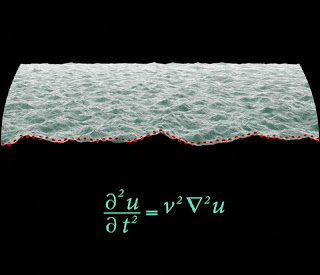
| Sea Waves (wave equation) image from the film Mathematical Paradises, 2011. |
Talking with Shaun recently about fractals and the questions they raise — are they art? are they science? Does the mathematical basis and quality of endlessness make this an 'aesthetic' or a 'natural' object? — reminded me of the persistent problem of vocabulary for the desire to talk across these particular disciplinary lines. In a book titled What is Philosophy?, a collaboration between a philosopher and a practicing psychoanalyst, Giles Deleuze and Felix Guattari express the problem in this way:
When philosophy compares itself to science it sometimes puts forward a simplistic image of the latter, which makes scientists laugh. … Paul Klee’s vision was certainly more sound when he said that mathematics and physics, in addressing themselves to the functional, take not the completed form but formation itself as their object. … If philosophy has a fundamental need for the science that is contemporary with it, this is because science constantly intersects with the possibility of concepts and because concepts necessarily involve allusions to science that are neither examples nor applications, nor even reflections.
(Deleuze and Guattari, What is Philosophy? 154-5, 162)
![]() |
| Ulam’s Spiral, in The Room of the Four Mysteries, part of a film by Beatriz Milhazes. |
It strikes me that Mathematics: A Beautiful Elsewhere is an attempt in the right direction at a real space of collaboration — the kind of thing that Deleuze and Guattari would call taking "not the completed form but formation itself as [its] object." This is for a couple of reasons. One, the sheer range of works and collaborations in the show. Each is a sincere attempt to bridge the gap through multiple types of visual languages, and in a range of different media, and no individual piece can claim to individually crack the problem. This variety is an important part of making the viewer aware of the potential heterogeneity of the art/science matrix. By comparison, the CERN residency picked only a single artist following a wide call for proposals, which is a relatively pre-determined approach that is more likely to fall into the trap of fixating on artistic personality.
Second, Michel Cassé — an astrophysicist and a co-curator of the Mathematics show — put a range of experienced specialists together, gave them an open brief, but required the outcome to take the form of an art exhibition. This is a useful constraint for a topic so predisposed to wander into the literally ineffable. And so, for all the occasional accusations of impenetrability by the critics, this is an approach to disciplinary collaboration that I hope we see more of in contemporary art: process-oriented, carefully conceptualized collaborations that are not just flashy "allusions to science" but that prioritize the actual objects, methods, and incipient discourses that might fail, may communicate only partly, but begin to construct the common vocabulary.
![]() |
| Live video feeds from experiments at the Large Hadron Collider in CERN, Geneva |
Labels:
art/science,
CERN,
onScale,
public,
Scheduled Posts
Tuesday, February 7, 2012
The invisible made visible
Last year, I uploaded a post about the Cell Picture Show, where researchers in the visualisation of molecular biology can exhibit some of their most impressive images. This month, Science has released its equivalent in the form of its visualisation challenge. This competition has been running for 9 years, with winners and honourable mentions announced in the categories of photography, illustration, informational graphics, interactive games and video. The examples this year are well worth a look - the image above is taken from the first place entry for informational graphics, entitle The Cosmic Web by Miguel. A. Aragon-Calvo et al. It depicts the overall structure of the Universe if you could see the various levels of organisation, and comes with a handy explanation for non-cosmologists like me. I really can't do it justice with this small image, so I encourage you to go and see the original for yourself! The people's choice winner for photography is entitled The Cliff of a Two-Dimensional World by Babak Anasori et al (below). There's something about this image that I love; the deep red on blue is reminiscent of the Grand Canyon, but in fact is what you see when you image ultrathin sheets of titanium compounds under an electron microscope.
The Science website also has archived records of previous years' winners, which are also well worth a look!
Image rights belong to Science and the original authors.
Labels:
aesthetics,
art/science,
cool things on the internet,
exhibitions,
interdisciplinary,
onScale,
wonder
Monday, January 30, 2012
On Scale
I recently encountered this "Scale of the Universe" widget: an animation tool that places the human body in the center of a sliding scale of dimensions ranging from the very big—the estimated size of the universe—to the unimaginable small of Quantum foam and string theory. Everything in-between is visualized comparatively: pollen grains set against Ultraviolet light and the width of human hair, mountain ranges against galactic distances.
The schema of extreme polarities in size reminded me of the two scientific images—an image of a cell and of an exploding star—I found so striking when thinking about impossible images. In many ways science works with scales that stretch the limits of the imaginable, or by using mathematics and data as forms of abstraction to manage the quantitatively big or the inconceivably small.
But conceiving scale concretely, as a visual image, can matter a lot in social ways. The first images of the earth from space created a point of view that had not existed before the 1960s, even though they described a concept that had been comprehended for centuries—a post-Copernican universe, in which the Earth is a planet among others. But those images entered the collective social imaginary instantly and viscerally, as something quantitatively new. In an odd way, the Apollo photographs didn’t de-centre the Earth into a universe wider than we can imagine so much as re-center it for our vision. By placing the whole Earth in the center of the frame of television images beamed to one of the first global audiences, those photographs let us see the planet in an entirety new way: as an entity. Many descriptions of these images invoke a sense of the fragility of the Earth, and they have been credited with contributing to a ecological consciousness.
![]() |
| Iñigo Manglano-Ovalle, Cloud Prototype No. 1 (2001), fiberglass and titanium alloy foil |
The schema of extreme polarities in size reminded me of the two scientific images—an image of a cell and of an exploding star—I found so striking when thinking about impossible images. In many ways science works with scales that stretch the limits of the imaginable, or by using mathematics and data as forms of abstraction to manage the quantitatively big or the inconceivably small.
But conceiving scale concretely, as a visual image, can matter a lot in social ways. The first images of the earth from space created a point of view that had not existed before the 1960s, even though they described a concept that had been comprehended for centuries—a post-Copernican universe, in which the Earth is a planet among others. But those images entered the collective social imaginary instantly and viscerally, as something quantitatively new. In an odd way, the Apollo photographs didn’t de-centre the Earth into a universe wider than we can imagine so much as re-center it for our vision. By placing the whole Earth in the center of the frame of television images beamed to one of the first global audiences, those photographs let us see the planet in an entirety new way: as an entity. Many descriptions of these images invoke a sense of the fragility of the Earth, and they have been credited with contributing to a ecological consciousness.
For the first time in my life I saw the horizon as a curved line. It was accentuated by a thin seam of dark blue light - our atmosphere. Obviously this was not the ocean of air I had been told it was so many times in my life. I was terrified by its fragile appearance.
-Ulf Merbold
Labels:
art/science,
onScale,
public,
Scheduled Posts,
wonder
Monday, December 19, 2011
Senses of Science
Four months ago I wrote a post about wonder in an attempt to sketch out the aspirational mood of this blog (or at least my sense of it). In six week increments since I’ve metaphorically returned to that mood and tried to make its implications more concrete by mapping out the actual directions that thinking about wonder and new lines of disciplinary mingling have led my own research: first, into the domain of science film, and second, into postulations about this genre within a critical category I called ‘the impossible image.’
So come December, I’ve decided to take the opportunity for reflection provided by the end of a calendar year and circle back to wonder, backlit by a sense of some things I’ve learned from this multi-directional conversation thus far. The hero of this post is an out-and-out iconoclast: the scientist and Surrealist filmmaker Jean Painlevé, whose six-decade career was devoted to the intertwining of science and art on every level. A biologist trained in the Laboratoire d’Anatomie et d’Histologie Comparée at the Sorbonne, Painlevé was an avant-garde photographer and filmmaker who penned countless texts, reviews, polemics, and manifestos; was politically active during and beyond the Second World War; and initiated a scientific film institute dedicated to supporting and disseminating science film well before the nexus of art and science was comprehended as a serious topic.
Best of all, Painlevé is a humorist. His mesmerizing films and delicate photographs, chatty
texts and sparking interviews give us a way to concretize a subtle quality of the aesthetics
of wonder—the significance of pleasure in the strangeness and
surprising beauty of the natural world. The mood of his contribution to
the history of our topic seems to me perfectly encapsulated in Foucault's riff on discovery and the affects of wonder:
So come December, I’ve decided to take the opportunity for reflection provided by the end of a calendar year and circle back to wonder, backlit by a sense of some things I’ve learned from this multi-directional conversation thus far. The hero of this post is an out-and-out iconoclast: the scientist and Surrealist filmmaker Jean Painlevé, whose six-decade career was devoted to the intertwining of science and art on every level. A biologist trained in the Laboratoire d’Anatomie et d’Histologie Comparée at the Sorbonne, Painlevé was an avant-garde photographer and filmmaker who penned countless texts, reviews, polemics, and manifestos; was politically active during and beyond the Second World War; and initiated a scientific film institute dedicated to supporting and disseminating science film well before the nexus of art and science was comprehended as a serious topic.
![]() |
| underwater bricolage: Jean Painlevé with his diving gear "Everything is the center of the world. I'm forced to be multicentric." |
Curiosity is a vice that has been stigmatized in turn by Christianity, by philosophy, and even by a certain conception of science. Curiosity is seen as futility. However, I like the word; it suggests something quite different to me. It evokes "care"; it evokes the care one takes of what exists and what might exist; a sharpened sense of reality, but one that is never immobilized before it; a readiness to find what surrounds us strange and odd; a certain determination to throw off familiar ways of thought and to look at the same things in a different way; a passion for seizing what is happening now and what is disappearing; a lack of respect for the traditional hierarchies of what is important and fundamental.
Labels:
aesthetics,
art/science,
cinema,
history,
old media,
onScale,
poetrees,
public,
Scheduled Posts,
wonder
Wednesday, November 23, 2011
"Nature, red in tooth and claw." and blue, and green, and yellow, and...
The picture above is a 'brainbow' created by a lab in Harvard - it is a fluorescent microscopy image of the hippocampus of a mouse genetically engineered to express three fluorescent proteins. Depending on how the genes of the individual neurones are randomly recombined, each cell will express a different combination of the three proteins, giving each a unique colour! I love the beauty of the resultant image, and it is a great example of the meeting of scientific and aesthetic research that is becoming more and more widespread. Another example is given below - natural fireworks revealed by labelling actin microtubules in dividing cells. These pictures and plenty of others are available in an online exhibition run by the journal Cell at the Cell Picture Show. The images are incredible and there are explanations of what's being shown for those without a biology background - well worth a visit!
Image rights belong to Cell and the original creators.
Labels:
aesthetics,
art,
art/science,
biochemistry,
cool things on the internet,
onScale
Monday, November 7, 2011
Three Impossible Images
1.
Of course this first one isn’t even an image, but a poem—a lyric. In this digital audio file at the SFMA Poetry Center you can hear Marianne Moore reading it. Listening to this clip is lovely, because it gives you a sense of the witty, self-depreciating charm of the personality behind the language.
If this poem is an ‘image,’ it is a drama of the almost-visible, starring a jellyfish. Quite a specific, individual jellyfish, swimming around as they do, and momentarily caught in a small poetic narrative. It is the jellyfish that is both visible and invisible: fluctuating, transparent, ethereal, sometimes translucent and sometimes highly colored, jewel-toned, gem-like, strangely compelling, very beautiful, intensely desirable, and alive.
The first lines of the poem contain so much all-over movement that you sense the liquidity before articulating it. Yet when the “arm/ approaches” everything changes. Suddenly it hits you that there’s no glass barrier, an aquarium or a zoo, to separate the person from the jellyfish, so that that this might actually be an eco-drama: a story of ecological ethics in which the arm is in the ocean with the jellyfish.
And this realization introduces two important other movements. When the arm drops back it registers fear, but also something else. “Abandon[ing] your intent” isn't exactly giving up. There’s a hint of purposeful letting go: a deliberate act of relinquishment, or an instinctive reaction to the liveness of the jellyfish’s quiver.
This poem is a kind of motionless animation. It is a drama in which what is not visible becomes more practically significant than we can see, so that a very attractive ‘thing’ is not removed from its environment.
![]() |
| Marianne Moore, A Jellyfish (1959) |
Of course this first one isn’t even an image, but a poem—a lyric. In this digital audio file at the SFMA Poetry Center you can hear Marianne Moore reading it. Listening to this clip is lovely, because it gives you a sense of the witty, self-depreciating charm of the personality behind the language.
If this poem is an ‘image,’ it is a drama of the almost-visible, starring a jellyfish. Quite a specific, individual jellyfish, swimming around as they do, and momentarily caught in a small poetic narrative. It is the jellyfish that is both visible and invisible: fluctuating, transparent, ethereal, sometimes translucent and sometimes highly colored, jewel-toned, gem-like, strangely compelling, very beautiful, intensely desirable, and alive.
The first lines of the poem contain so much all-over movement that you sense the liquidity before articulating it. Yet when the “arm/ approaches” everything changes. Suddenly it hits you that there’s no glass barrier, an aquarium or a zoo, to separate the person from the jellyfish, so that that this might actually be an eco-drama: a story of ecological ethics in which the arm is in the ocean with the jellyfish.
And this realization introduces two important other movements. When the arm drops back it registers fear, but also something else. “Abandon[ing] your intent” isn't exactly giving up. There’s a hint of purposeful letting go: a deliberate act of relinquishment, or an instinctive reaction to the liveness of the jellyfish’s quiver.
This poem is a kind of motionless animation. It is a drama in which what is not visible becomes more practically significant than we can see, so that a very attractive ‘thing’ is not removed from its environment.
Labels:
aesthetics,
art,
art/science,
history,
interdisciplinary,
motivation for the blog,
old media,
onScale,
Scheduled Posts,
wonder
Friday, October 7, 2011
Total Perspective Vortex
[I apologise to all readers of the blog who also take the time to read the comments because you have probably already have seen the following videos. For those who don't read the comments, you're missing out on half of the purpose of the blog.]
Michelle asked in this post what role cinema plays in science. I think this is an interesting question and a smart choice of post from Michelle. Opening a dialogue between science and art isn't easy. We speak very different languages. We sometimes tackle similar questions, but we do the tackling in very different ways. Moving images though are something that exist in both worlds. They may be used very differently, but that's the interesting thing; how are they used differently? How are they used similarly? There are tools such as sculpture and advanced mathematics that probably aren't used in both worlds, but moving images are.
So moving images are a great example for this blog because they give us that first piece of common ground from which to begin a conversation.
My first contributions to Michelle's questions were the following two films. They are the best examples I know of that properly show how insignificant the Earth is. Watch them in high definition.
The first film, above, is a film of the dark matter particles in the Millenium Simulation. This is what we expect the universe should look like if we could see the dark matter in it. As stated in the wikipedia link, each individual particle in this simulation (i.e. pinprick of light in the film) has a mass one billion times the mass of the sun. Not only that, but the total volume of the simulation is much less than the total volume of the observed universe. Keep that in perspective when watching... this video shows only a small fraction of the total volume of the universe and each dot in the video is much bigger than an entire galaxy! (don't forget that one galaxy will itself be 100,000 light years wide - this is so big that in one human lifetime light could only travel 0.1% of its width - and that is just one galaxy, something just big enough [edited from the original - "not big enough"] to be seen in this video.)
The film above is the real world equivalent. This film shows the locations of individual galaxies in the observed universe as seen by the Sloan Digital Sky Survey. SDSS has only mapped a fraction of the sky and can only see galaxies that are within a certain distance of us. So you see less of the universe, but at a finer resolution. In each galaxy in this video there will be billions and billions of stars just like our sun. This website helps if you find it hard to visualise what the number one billion actually means.
As the conversation develops I will hopefully find time to explain the scientific gains from both SDSS and the Millenium Simulation as well as what a scientist gains from watching the films themselves. But for now, let's just treat these as eye candy for the weekend as we wait for James' next proper post, due to arrive on Monday.
Follow @just_shaun
Labels:
cinema,
cool things on the internet,
cosmology,
galaxy clusters,
onScale,
THHGTTG,
wonder
Thursday, September 29, 2011
Computer games, science and Foldit
Next Monday we will be having our first ever guest post (I know, I know, exciting right?). In anticipation of this great event and because it is loosely related I thought I would mention the following piece of incredible innovation humanity has shown.
Now ordinarily a game like this might be a quaint example of a clever scientist coming up with an innovative way to make his research more popular and understandable. However, this is not actually the primary aim of Foldit at all. The aim of Foldit is to use the insight and cleverness of the gamers to advance the science itself.
This sounds like a ridiculous idea, but as you can see in the video below, it turns out that the Foldit experiment isn't doing so badly.
And, as explained in this article at Nature News Blog, at an annual competition, intended for biochemists to predict the shapes of proteins, a team of Foldit players did surprisingly well. In fact, they made a genuine scientific discovery. From the article:
Foldit’s biggest success so far came after CASP9 [the annual competition], on an enzyme produced by a retrovirus called Mason-Pfizer monkey virus (M-PMV). A player who goes by the name 'mimi' came up with a shape that would be accurate enough to serve as the basis for determining the real shape of the protein based on X-ray diffraction measurements
"The M-PMV structure had stumped scientists for a very long time before Foldit players made their breakthrough. This is the first example I know of game players solving a long-standing scientific problem," Baker wrote in an email.You can find the game itself here.
How is this related to the upcoming guest post? Hah, you'll have to come back next Monday if you want to know the answer to that. In the meantime, don't forget to read the comments and join in with the discussion relating to Michelle's post below.
Follow @just_shaun
Labels:
art/science,
biochemistry,
collaboration,
computer games,
onScale
Thursday, September 22, 2011
Life, Jim, but not as we know it!
This is a video of cell-like structures being made from entirely non-organic components by a group in Glasgow. Primarily these so-called 'iCHELLS' (inorganic chemical cells) are made from metallic compounds, such as tungsten reacted with phosphate and oxygen. The bubble that results from injecting these compounds into a high-salt solution allows some molecules through but not others, much in the same way that a cell membrane does, and putting bubbles within these bubbles mimics the organisation of a real-life cell. The group is currently working on adding light-sensitive dyes to specific compartments in an attempt to recreate photosynthesis and generally making their structure and chemistry more complex and life-like.
This is an impressive achievement and whilst it's still absolutely no where near being a real, living cell, it does demonstrate that life in other parts of the universe may be based on entirely different chemistry to that on Earth! If that's the case then the number of potential planets that could support life may be massively more than our current estimates. This sort of thinking has been knocking around for a while now, but this is the first time that we've successfully recreated what it might look like in the lab! If you want more detail, have a look at the researchers' original paper or head over to a more thorough article in the New Scientist.
Monday, September 12, 2011
Pink elephants in the universe.
![]() |
| The bullet cluster (see comments for description) |
Suppose you woke up early tomorrow morning, looked at the sky, and some stars had turned pink and re-arranged themselves into the shape of an elephant. I imagine that you would think that something odd had happened. Naturally, you would probably decide that your earlier beliefs about stars were not quite complete and needed to be fixed.
Astronomers and cosmologists try to play the same game with very massive objects in the universe. The idea is the same. If we were to observe some objects large enough that they were as unlikely to exist as a pink elephant floating around in intergalactic space, then we would also be able to conclude that our standard beliefs about how large objects form in the universe is incomplete.
We do this because both the standard cosmological model and standard model of particle physics aren't particularly satisfying, but fit (almost) all the measured data really well. So we search for things to measure that might point us to something new and will give us an insight in to why these models work so well. Of course, it is also useful to simply measure as many new things as possible. History is littered with moments where we didn't bother measuring something because we knew what the result would be, only to get a big surprise whenever someone finally did measure it. So nowadays if something is measurable, then someone, somewhere, is trying to measure it. The biggest objects in the universe are nice. Because they are big, we can see them. They are measurable.
Labels:
cosmology,
galaxy clusters,
onScale,
Scheduled Posts
Tuesday, September 6, 2011
London International Animation Festival
The following is a video that recently aired at the London International Animation Festival. It is an amazing mixture of art and science. There is of course a lot of artistic license in the interpretation of the science, but who cares when the animation is this good! The animation is an incredible 10 minute long, stop-motion, wall graffiti, interpretation of the history of the universe and life on earth.
It seems to have won the "audience favourite" in one of the many categories considered as well, so at least one audience has chosen nicely. Well, anyway, watch and enjoy...
BIG BANG BIG BOOM - the new wall-painted animation by BLU from blu on Vimeo.
The artists' website is BluBlu.org if anyone is interested in seeing more awesome wall graffiti. Follow @just_shaun
It seems to have won the "audience favourite" in one of the many categories considered as well, so at least one audience has chosen nicely. Well, anyway, watch and enjoy...
The artists' website is BluBlu.org if anyone is interested in seeing more awesome wall graffiti. Follow @just_shaun
Labels:
art/science,
cool things on the internet,
onScale
Subscribe to:
Posts (Atom)


