Friday, September 23, 2011

Yet another voice in the neutrino OPERA


I feel just a little prophetic, given that only a week ago I wrote,
“... it is also useful to simply measure as many new things as possible. History is littered with moments where we didn't bother measuring something because we knew what the result would be, only to get a big surprise whenever someone finally did measure it. So nowadays if something is measurable, then someone, somewhere, is trying to measure it.”

Well, true to the claim, someone out there had the ridiculous idea that measuring the speed of neutrinos was a good idea, go figure. And, lo and behold, it seems they've found something! Maybe? Who knows!

Well, what sort of blog writer, who is a scientist (physicist even), would I be if I didn't join in with the neutrino cacophony? So, what follows is my attempt to say something interesting that hasn't already been said a million times already. I will focus on why this is such a surprising result and why this means nobody believes it.

This disbelief has nothing to do with the quality of the experiment. The measurement was recorded with impeccable accuracy and has been extremely carefully analysed. Neither is the disbelief because the result "proves Einstein wrong". It even has very little to do with the prospect of over-turning special relativity.

The disbelief is due to the fact that this observation brings into question the holy principle of causality – that is, the seemingly incontrovertible fact that cause must come before effect and not after

And, as my former PhD supervisor, said in the Guardian today:

“If we do not have causality, we are buggered."

Thursday, September 22, 2011

Life, Jim, but not as we know it!


This is a video of cell-like structures being made from entirely non-organic components by a group in Glasgow. Primarily these so-called 'iCHELLS' (inorganic chemical cells) are made from metallic compounds, such as tungsten reacted with phosphate and oxygen. The bubble that results from injecting these compounds into a high-salt solution allows some molecules through but not others, much in the same way that a cell membrane does, and putting bubbles within these bubbles mimics the organisation of a real-life cell. The group is currently working on adding light-sensitive dyes to specific compartments in an attempt to recreate photosynthesis and generally making their structure and chemistry more complex and life-like.
This is an impressive achievement and whilst it's still absolutely no where near being a real, living cell, it does demonstrate that life in other parts of the universe may be based on entirely different chemistry to that on Earth! If that's the case then the number of potential planets that could support life may be massively more than our current estimates. This sort of thinking has been knocking around for a while now, but this is the first time that we've successfully recreated what it might look like in the lab! If you want more detail, have a look at the researchers' original paper or head over to a more thorough article in the New Scientist.

Tuesday, September 20, 2011

Snapshots from the trenches: Stockholm clusters workshop

As a part of contributing to this blog, I am going to try to write quick-ish summaries of any papers I co-author and any conferences or workshops I attend. Though, unlike the commitment to a new post every six weeks, I make no promises about how well I'll keep to this particular aim. These posts will inevitably be the most technically demanding of my posts, but also, potentially the most rewarding. They will be demanding because I won't choose to spend a lot of time writing them, but, more importantly, because the physics I will be discussing will be fresh off the press. As a result, it will not be written in a coherent, packaged, easily understood, form.

But, here's the thing, research is never in that form, even for those who are immersed in the field. It is only when we look back on past research with the benefit of time that we can see it in a form that can be packaged in a complete and coherent picture (the galaxy clusters stuff I wrote last week took physicists more than decades to properly understand). By this time it is no longer 'research', but simply 'past results'.

Often scientific knowledge is only popularised for the consumption of those outside of the field once it has reached this final, 'packagable', state. This is great, but the awesome thing about a blog like this (and the many other similar blogs) is that we can also give you a real-time view inside the research trenches. We can discuss what people are working on, thinking about and discovering, right now. It may be more difficult to follow than a coherent look back, but it should be more exciting to follow, and, as other blogs have shown, it is definitely possible to do. You don't have to follow every line of every calculation, to be pointed to a final number, or final figure in a paper and, when given the context, use that to reach the same conclusions as the authors. Yes, even in the actual, raw, unadulterated, not fit for the eyes of the young and innocent, scientific, papers! That's the goal, at least.

It shouldn't end up being too much more difficult than keeping track of various sports teams and players during a season of professional sport.

I think that giving this view from inside the trench is really important. Popularising scientific results in neat packages isn't a bad thing, it is great to help us all understand what is known and what has been achieved. The problem is when it is only the final package that the public ever sees. Then what is hidden from view is how we know the result and what we did to learn it. When it is only ever the final result that is seen it gives a skewed perception of how science proceeds, which I think can be damaging.

Friday, September 16, 2011

When Science (Fiction) meets Art


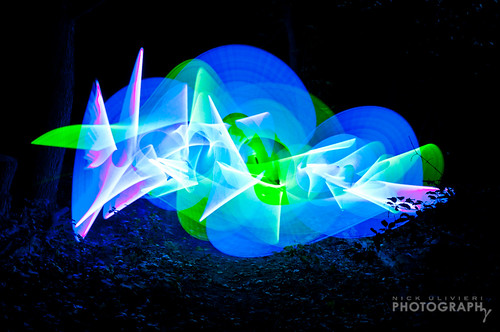
So it is a little bit outside of the scope of the blog, but this image is starting to go viral and I like it. I came to see it from blog follower Matt's twitter feed when he retweeted it from the original. You can click the image to see more images of a similar nature.

It is what happens when you play with a light-saber in front of a camera with a very long exposure time. The photography method is called light painting. Now if a reader would kindly invent a real light-saber I can claim that this piece of artwork is a wonderful example of art enriching science. Those interested can discuss in the comments (the blog owners will require 10% of any eventual profits made).


Monday, September 12, 2011

Pink elephants in the universe.

The bullet cluster (see comments for description)


Suppose you woke up early tomorrow morning, looked at the sky, and some stars had turned pink and re-arranged themselves into the shape of an elephant. I imagine that you would think that something odd had happened. Naturally, you would probably decide that your earlier beliefs about stars were not quite complete and needed to be fixed.

Astronomers and cosmologists try to play the same game with very massive objects in the universe. The idea is the same. If we were to observe some objects large enough that they were as unlikely to exist as a pink elephant floating around in intergalactic space, then we would also be able to conclude that our standard beliefs about how large objects form in the universe is incomplete.

We do this because both the standard cosmological model and standard model of particle physics aren't particularly satisfying, but fit (almost) all the measured data really well. So we search for things to measure that might point us to something new and will give us an insight in to why these models work so well. Of course, it is also useful to simply measure as many new things as possible. History is littered with moments where we didn't bother measuring something because we knew what the result would be, only to get a big surprise whenever someone finally did measure it. So nowadays if something is measurable, then someone, somewhere, is trying to measure it. The biggest objects in the universe are nice. Because they are big, we can see them. They are measurable.

Tuesday, September 6, 2011

London International Animation Festival

The following is a video that recently aired at the London International Animation Festival. It is an amazing mixture of art and science. There is of course a lot of artistic license in the interpretation of the science, but who cares when the animation is this good! The animation is an incredible 10 minute long, stop-motion, wall graffiti, interpretation of the history of the universe and life on earth.

It seems to have won the "audience favourite" in one of the many categories considered as well, so at least one audience has chosen nicely. Well, anyway, watch and enjoy...


BIG BANG BIG BOOM - the new wall-painted animation by BLU from blu on Vimeo.


The artists' website is BluBlu.org if anyone is interested in seeing more awesome wall graffiti.

Friday, September 2, 2011

Arts@CERN

I received a nice email today from Gareth, a good friend and follower of this blog. He forwarded me a link to something called Collide@CERN, which seems very relevant to the blog's purpose.

Before talking about Collide@CERN, let me briefly discuss CERN. CERN is the particle physics laboratory that houses the Large Hadron Collider (LHC). The LHC really is an incredible experiment, not just because of what it is measuring, but also because humanity decided to pool enough of its resources together and devote enough collective time to it to actually build and use it. I won't go into detail as to what the LHC actually does (CERN does a very good job of publicising this themselves – and perhaps Gareth might be tempted into writing a guest post for us) but it is definitely the most important particle physics experiment that exists today and is basically studying what nature does at the smallest lengths and highest energies that we have ever studied. Coincidentally, very early on in its history, the universe was extremely hot and dense, so the laws and patterns observed by the LHC are also very relevant to the early stages of the universe. This is why CERN will often claim that the LHC is “recreating the conditions during the big bang”.

In any case, CERN have always been very, very good at outreach. It doesn't really surprise me that the most ambitious and most difficult experiment humanity has ever attempted is run by an organisation that tries so hard and so effectively to explain and popularise what it does. People care about what they know about and they know about what they are introduced to. If anyone is ever visiting Switzerland, it is well worth it to actually visit CERN. Not only will you be participating in a sort of high energy physics pilgrimage, but you should find CERN well catered to non-specialist tourists as well. I'd even go as far as to say you should consider visiting Geneva just to see CERN!

If I can allow myself to get to the point, Collide@CERN is a programme CERN is just starting that goes beyond just outreach and is part of a concerted effort by CERN to actively engage with the arts through what they've called Arts@CERN. Collide@CERN is a competition for artists. From the press release I linked to:
"The prize consists of a two-part residency. Two months will be spent at CERN, where the winning artist will team up with a scientist as inspirational partner; then one month will be spent at Ars Electronica, where the artist will develop work inspired by the time spent at CERN."
The programme seems to have some prominent artists behind it, as well as reasonably substantial funding.

I've always found CERN's contribution to science popularisation impressive. These new steps impress me even more. I'm intrigued to see how Arts@CERN develops. Perhaps some of our current and/or future readers might even be interested in entering the competition.

For anyone on twitter... both @CERN and @ArtsAtCERN have twitter accounts.